iAspirants
Advancements in Nuclear Fusion Technology
Published on:
Share this post
Article Summary
Summary of Recent Advances in Nuclear Fusion Research
Key Scientific Developments:
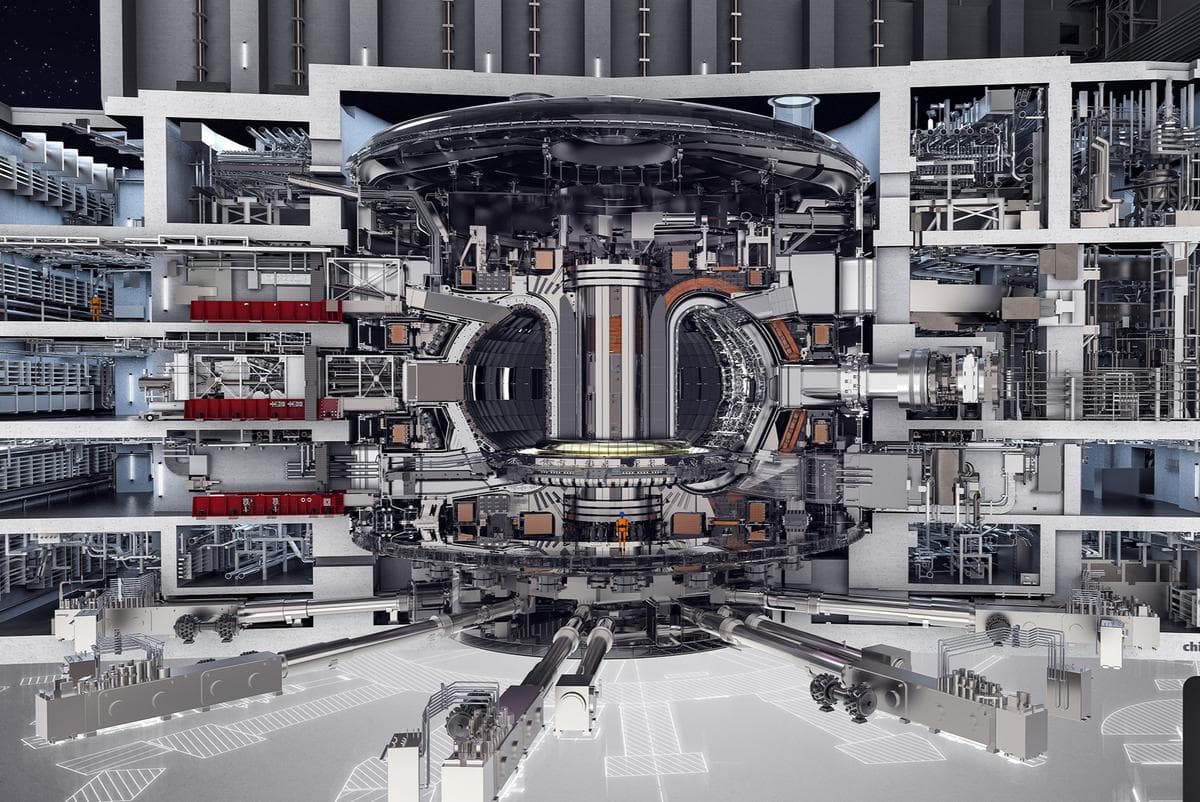
- China's EAST Fusion Reactor: Scientists at the Experimental Advanced Superconducting Tokamak (EAST) in Hefei, China, have achieved a breakthrough by operating the reactor at a plasma density 65% beyond the established Greenwald limit, which is a significant step toward achieving a self-sustaining fusion reaction (burning plasma).
- Fusion Process: Fusion mimics the sun's internal processes, where hydrogen atoms fuse into helium at extremely high temperatures exceeding 100 million degrees Celsius, releasing vast amounts of energy.
Technical Insights:
- Triple Product: Success in fusion reactors is measured using the triple product: density (number of particles), temperature, and confinement time. High values in all three are required for ignition (self-sustaining fusion).
- Greenwald Limit: The Greenwald density limit, linked to plasma current and reactor size, traditionally restricts operating densities in fusion reactors.
Notable Achievements:
- Experiment Results: EAST operated plasma densities up to 5.6 × 10^19 particles/m³ (65% higher than normal, which is 3.4 × 10^19 particles/m³) with a lower plasma temperature near the divertor reduced from 1.1 million to approximately 0.7-0.8 million degrees Celsius.
- Techniques Used:
- Electron Cyclotron Resonance Heating (ECRH): Utilized to heat plasma electrons before increasing plasma current.
- Deuterium and Hydrogen Fuel Strategy: Starting with deuterium gas and subsequently feeding hydrogen improved plasma stability and density.
Theoretical Framework:
- Plasma-Wall Self-Organization Theory (PWSO): Developed in 2021, this theory predicts two stable states of plasma: a density-limit regime near the Greenwald limit and a density-free regime, which allows for higher densities. This theory was validated by recent EAST results.
Implications for Future Research:
- Potential for Ignition: Higher plasma density could allow reactors to achieve ignition at lower temperatures or shorter confinement times, representing a significant advancement for fusion energy applications.
- Importance for ITER: The findings have implications for ITER, the international fusion research project in France, wherein India has invested, especially regarding overcoming the density limit challenges.
Challenges Ahead:
- Experimental Limitations: Current experiments have been conducted at low power and for short durations, significantly shorter than what would be needed for practical energy generation.
- Future Research Directions: Further increasing ECRH power and gas pressure could enhance performance and contribute to achieving operational conditions for future fusion power plants.
Conclusion:
The advancements in plasma density control at the EAST reactor provide a promising pathway for the development of sustainable fusion energy, highlighting the significance of international collaborations in the field of nuclear fusion and its potential to revolutionize energy production.
Key Terms & Concepts
| EAST fusion reactor | Achieved stable plasma density |
| Greenwald density limit | Threshold for plasma stability |
| 1.3x to 1.65x limit | Density achieved in experiments |
| 100,000,000º C | Required temperature for fusion |
| 600 kW | ECRH power used |
| 5.6 × 10^19 particles/m³ | Achieved plasma density |
| 0.7-0.8 million degrees C | Plasma temperature at divertor |
| ITER | International fusion project |
| PWSO theory | Predicts plasma behavior |
| Huazhong University of Science and Technology | Research institution involved |
| Japan National Institutes for Quantum and Radiological Science and Technology | Institution commenting on findings |