iAspirants
Africa's Forests Shift From Carbon Sink
Published on:
Share this post
Article Summary
Summary of Key Points
Climate Change and African Forests
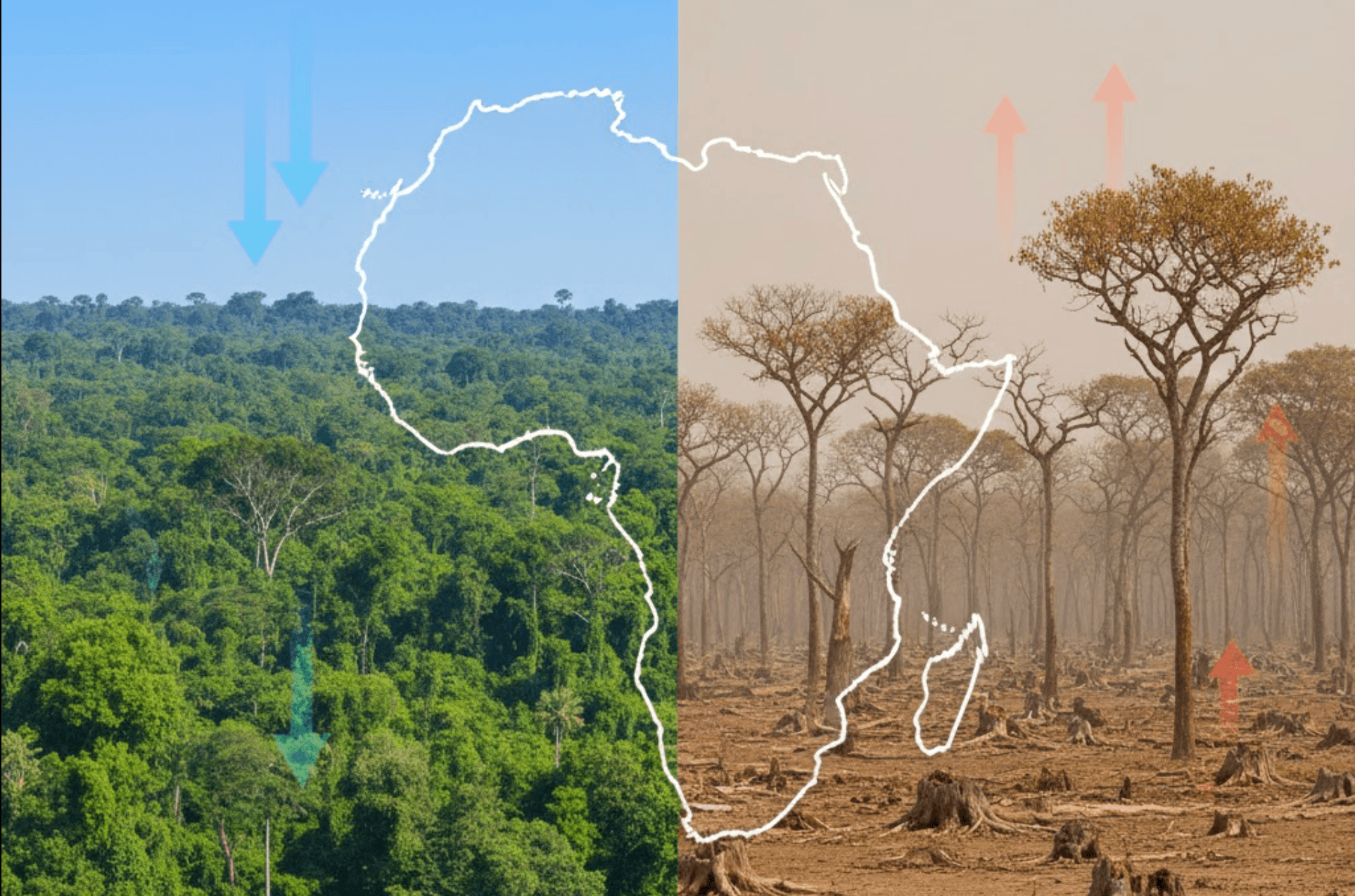
- A study published in Scientific Reports indicates that Africa's forests, once significant carbon sinks, have become carbon sources since 2017.
- The world's three major rainforest regions (Amazon, Southeast Asia, and Africa) are contributing to global warming by emitting more carbon than they absorb.
Research Findings
- Conducted by researchers from the National Center for Earth Observation (Universities of Leicester, Sheffield, and Edinburgh), the study analyzes carbon storage through satellite-derived maps from 2007 to 2017.
- Historical role: African tropical forests absorbed over 1 billion tonnes of CO2 annually (Nature, 2023).
- From 2010 to 2017, African forests lost approximately 106 billion kg of biomass per year, equivalent to the weight of 106 million cars.
- The worst affected regions: Tropical moist broadleaf forests in the Democratic Republic of Congo, Madagascar, and West Africa.
Human Impact
- The transformation to carbon sources is attributed to:
- Deforestation for agriculture.
- Fuelwood burning.
- Infrastructure projects and mining.
- Wildfires contributing significantly to carbon emissions.
Implications and Urgency
- Failure of African forests to act as carbon sinks complicates global climate targets. The global average temperature has risen by at least 1.2 degrees Celsius above pre-industrial levels.
- Projections indicate potential temperature increases of 2.8 to 3.1 degrees Celsius by the century's end if carbon emissions are not drastically reduced.
International Agreements and Initiatives
- The Tropical Forest Forever Facility (TFFF), launched at COP30 in Brazil, seeks to raise $125 billion for forest conservation, targeting developing nations. Only a few countries have committed to this fund.
- At COP26 in Glasgow, leaders aimed to end global deforestation by 2030, but progress remains insufficient, underscoring the need for greater international cooperation and funding.
Key Takeaways
- Urgent action is required:
- Continued funding and investment in conservation initiatives.
- Addressing the drivers of deforestation (mining, agricultural expansion).
- Multinational commitment to forest preservation is essential for achieving climate goals.
Conclusion
The shift in African forests from carbon sinks to carbon sources reveals the critical need for enhanced global efforts in forest conservation and renewed commitments to international climate objectives.
Key Terms & Concepts
| Africa’s forests | Carbon source after 2017 |
| 1 billion tonnes of CO2 | Annual carbon absorption by forests |
| 106 billion kg of biomass | Annual biomass loss from forests |
| Tropical Forest Forever Facility (TFFF) | Initiative to fund forest conservation |
| $125 billion | Planned investment for TFFF |
| COP30 | Event where TFFF launched |
| COP26 | Previous conference on deforestation |
| 1.2 degrees Celsius | Temperature increase since pre-industrial levels |
| 2.8 to 3.1 degrees Celsius | Projected temperature rise by century's end |
| democratic Republic of Congo, Madagascar, West Africa | Regions with severe forest loss |