iAspirants
Approval of GOBARdhan National Scheme
Published on:
Share this post
Article Summary
National Circular Bioenergy Scheme – GOBARdhan Overview
Government Approval:
- The Union Cabinet approved the National Circular Bioenergy Scheme – GOBARdhan with an outlay of ₹23,731 crores, aimed at enhancing the production of compressed biogas (CBG).
Duration:
- The scheme is effective until 2036.
Objectives:
- Increase domestic CBG production nearly ten-fold.
- Establish a stable framework for the CBG ecosystem through:
- Assured offtake
- Administered pricing
- Capital subsidies
- Infrastructure development
- Easier access to finance
Feedstock Utilization:
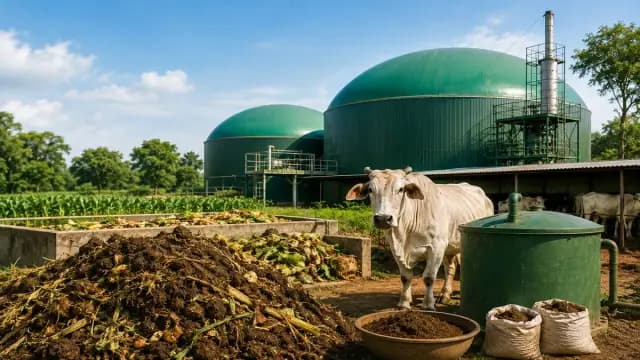
- CBG will be produced from:
- Agricultural residue
- Cattle dung
- Sugar industry waste
- Municipal organic waste
- Other biomass
Impacts on Industry:
- Goal to increase operational plants from approximately 300 to 5,000, creating lakhs of rural jobs.
- A.R. Shukla, President of the Indian Biogas Association, emphasized key imperatives addressed by the scheme: remunerative prices, assured offtake, and capital support.
Infrastructure Development:
- Essential development of pipeline infrastructure to ensure reliable CBG distribution.
- Support for both cluster-based and standalone pipeline infrastructure linking CBG plants with trunk pipelines and city gas networks.
- Increased pipeline connectivity is expected to:
- Lower evacuation costs
- Enhance reliability and market reach
- Improve utilization of domestically-produced CBG
Pricing Mechanism:
- Administered price set at ₹2,110 per Metric Million British Thermal Unit (MMBTU) for CBG.
- Aimed at providing long-term revenue visibility and protecting consumer affordability through a combination of government support and market-based cost-sharing.
Financial Assistance:
- Capital assistance of up to ₹2 crore per ton per day (TPD) for eligible greenfield and brownfield CBG projects.
- Support covers core plant machinery, feedstock aggregation, and manure processing.
- Aims to reduce initial capital burdens, accelerate financial closures, and encourage participation by private entities, MSMEs, and rural entrepreneurs.
Broader Economic and Environmental Goals:
- Expected outcomes include:
- Spurring private investment
- Creating income opportunities for farmers and rural entrepreneurs
- Enhancing management of agricultural and municipal waste
- Expanding organic manure production
- Lowering greenhouse gas emissions
- Alignment with national goals of:
- Energy security
- Waste-to-wealth initiatives
- The vision of Atmanirbhar Bharat (self-reliant India)
- The vision for a Viksit Bharat (developed India)
Significance:
- The GOBARdhan scheme is seen as a significant step towards establishing a nationally scaled clean energy industry, reflecting the government's commitment to sustainable energy and rural enterprise development.
Key Terms & Concepts
| GOBARdhan | National Circular Bioenergy Scheme |
| ₹23,731-crore | Funding for CBG growth |
| 2036 | Scheme duration |
| ₹2,110 per Metric Million British Thermal Unit (MMBTU) | Administered price for CBG |
| 5,000 plants | Target for CBG production |
| ₹2 crore per tonne per day (TPD) | Capital assistance for projects |
| MMBTU | Unit for measuring CBG |
| Atmanirbhar Bharat | Self-reliant India initiative |
| Viksit Bharat | Vision for developed India |