iAspirants
Challenges of Electric Vehicle Adoption
Published on:
Share this post
Article Summary
Exam-Focused Notes on Electric Vehicles (EV) in Karnataka
Constitutional References
- Right to a Clean Environment: Under Article 21 of the Indian Constitution, citizens have the right to a clean environment, which can be supported through cleaner mobility options such as electric vehicles.
Government Policies and Schemes
- FAME-II Scheme: The Faster Adoption and Manufacturing of Hybrid and Electric Vehicles in India II allocates ₹912.5 crore for EV charging infrastructure across the country, with a significant amount already released.
- PM E-DRIVE: A government initiative earmarking ₹2,000 crore specifically for expanding EV charging infrastructure nationwide.
- State EV Policies: Karnataka has been proactive in formulating policies to encourage EV adoption and infrastructure development.
Economic Data
- Market Penetration and Growth:
- India's EV market is expected to reach approximately 10% penetration by FY 2026-27.
- Karnataka registered 54,000 electric vehicles between January and March 2026, marking it as the second-largest hub for public EV charging stations in India.
- Operational EV public charging stations in Karnataka reached 2,039, up from just 36 in 2020-21.
Infrastructure Development
- Charging Stations:
- Karnataka accounts for 23% of India's public charging infrastructure, primarily concentrated in Bengaluru.
- Charging station growth: Jumped from 36 stations in 2020-21 to 542 in 2022-23 and then to 478 in 2023-24.
- The state expects to add 608 EV charging stations across all districts, with fast DC chargers specifically tailored for heavy vehicles.
Industry Insights
- Major oil marketing companies like Indian Oil, Bharat Petroleum, and Hindustan Petroleum are leading the deployment of EV charging infrastructure, totaling close to 30,000 charging sites across their networks nationwide.
Challenges Facing EV Adoption
Charging Infrastructure:
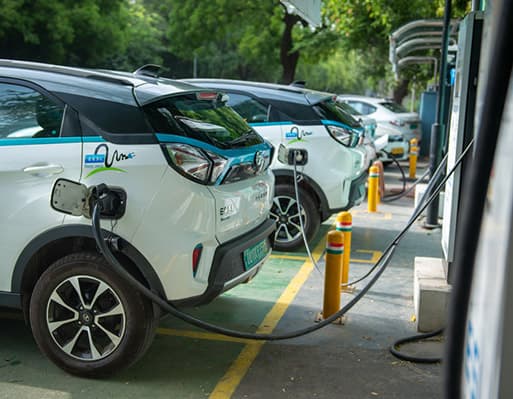
- High EV-to-charger ratio of 235:1 poses challenges for long-distance travelers regarding charging availability.
- Limited charging facilities in many apartment complexes hinder home charging.
Range Anxiety:
- Concerns regarding the availability of charging stations, especially during long-distance travel.
Charging Duration:
- Standard home charging takes 6-12 hours, while fast chargers reduce this to 30 minutes to 1 hour.
Cost Considerations:
- Higher upfront costs deter many from purchasing EVs, despite lower operational costs.
- Concerns regarding battery life and replacement costs remain substantial barriers.
International and National Importance
- India's shift towards EVs is critical for reducing oil imports and emissions, aligning with global energy security strategies amidst fluctuating fuel prices.
Technological Developments
- Ongoing advancements in battery technology and charging solutions, with companies like Ather Energy investing heavily in battery safety and performance.
Recommendations for Future Growth
- Greater regulatory harmonization between governmental bodies will be essential for the successful integration of EVs and charging infrastructure.
- Efforts to improve accessibility and reliability of charging stations are necessary to enhance consumer confidence in EV usage.
Conclusion
Karnataka exemplifies the emerging EV landscape in India, illustrating rapid market growth alongside significant challenges in infrastructure and user acceptance. Strategic governmental and industrial efforts focused on improving the charging ecosystem, consumer awareness, and legislative support are crucial for the transition to electric mobility.
Key Terms & Concepts
| Karnataka EV market penetration | Projected to reach 10% by FY 2027 |
| Public charging infrastructure | Over 29,000 units available |
| Fuel prices | Soaring, leading to EV interest |
| FAME-II scheme | ₹912.5 crore sanctioned for EV charging |
| PM E-DRIVE scheme | ₹2,000 crore earmarked for charging infrastructure |
| Bengaluru-Mangaluru route | Busiest inter-city corridor |
| 2,039 EV public charging stations | Operational in Karnataka |
| EV adoption investment | Over ₹25,000 crore in Karnataka |
| Charging time | 30 minutes to 1 hour for fast chargers |
| VAHAN dashboard | Data source for EV registration |
| Battery Waste Management Rules, 2022 | Regulations for battery management |