iAspirants
China-Pakistan Boundary Agreement Dispute
Published on:
Share this post
Article Summary
Summary of Key Facts and Developments
Constitutional and Legal Context
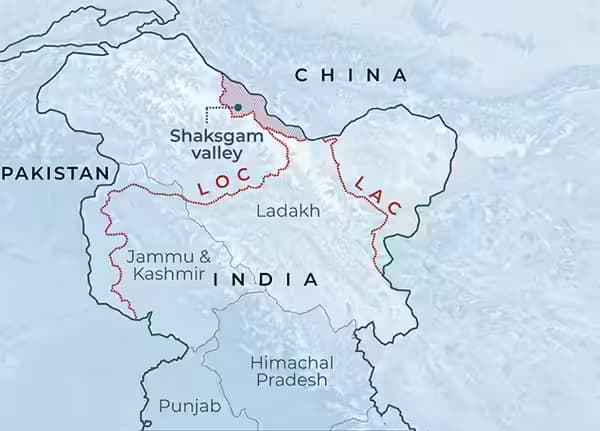
- 1963 China-Pakistan Boundary Agreement: India does not recognize this agreement, asserting it is illegal and invalid as it involved ceding parts of Indian territory (specifically, 5,180 sq. km of Shaksgam Valley) by Pakistan to China without India's consent.
- Article 6 of the Agreement: Stipulates that after resolving the Kashmir dispute, the designated sovereign will reopen negotiations for a formal boundary treaty with China.
- Nehru's Statement: In 1963, PM Jawaharlal Nehru expressed concerns that the timing of the China-Pakistan agreement was intended to negatively affect ongoing talks regarding Kashmir.
Territorial Claims
- Shaksgam Valley: Claimed by India and considered part of Ladakh, currently under Pakistan's control but ceded to China in the 1963 agreement. Its area exceeds 5,000 sq. km.
- Historical Context: The region has been a point of conflict with both India and China asserting territorial claims. China has claimed parts of Aksai Chin, changing the dynamics following the 1962 Sino-Indian War.
Government Statements
- Indian Stance: The Indian Ministry of External Affairs maintains that all of Jammu and Kashmir, including the Shaksgam Valley, is integral to India. Both the Chinese infrastructure developments in the region and the China-Pakistan Economic Corridor (CPEC) traversing through this area have faced high-level objections from India.
China-Pakistan Economic Corridor (CPEC)
- Purpose: Launched in 2015, CPEC aims to connect Gwadar Port in Pakistan to Kashgar in China, intending to provide an alternate route for oil imports and enhance economic ties through various infrastructure projects.
- Investment Figures: Total Chinese investment in the CPEC is estimated above $62 million, though implementation has faced challenges due to local insurgencies and Pakistan's economic conditions.
- Indian Objections: India considers the CPEC an infringement on its sovereignty as it runs through areas it claims are illegally occupied by Pakistan.
International Relations and Security Concerns
- Indian Protests: The Indian government has made numerous protests regarding both Chinese activities in Shaksgam Valley and CPEC developments, viewing them as undermining its territorial integrity.
- Regional Dynamics: The relationship between China and Pakistan, characterized as "ironclad," contrasts with India's historical alliances and geopolitical strategies, particularly with the United States during the Cold War.
Current Developments
- Infrastructure Challenges: While CPEC has ambitious plans, its execution has been interrupted by various issues, including security threats from Baloch militants and broader economic difficulties in Pakistan.
Conclusion
The geopolitical tensions in the region are accentuated by historical treaties, military claims, and ongoing infrastructural projects. India's firm position on its territorial claims reflects its stance on sovereignty and integrity amidst complex international relationships. The CPEC and its implications continue to be a point of contention between India, China, and Pakistan.
Key Terms & Concepts
| Shaksgam Valley | Disputed territory claim |
| China-Pakistan Economic Corridor (CPEC) | Infrastructure project in PoK |
| 1963 boundary agreement | China-Pakistan territorial claim |
| Jawaharlal Nehru | Indian Prime Minister's statement |
| 38,000 sq. kms. | Area of Indian territory in Ladakh |
| 5,180 sq. kms. | Area ceded in Shaksgam Valley |
| Gwadar port | End point of CPEC |
| $62 million | Chinese investments in CPEC |
| 1962 | Year of Sino-Indian war |
| Calcutta talks | Negotiations over Kashmir |