iAspirants
Civil Unrest in Pakistan-occupied Kashmir
Published on:
Share this post
Article Summary
News Summary on Civil Unrest in Pakistan-occupied Kashmir (PoK)
Background and Protests:
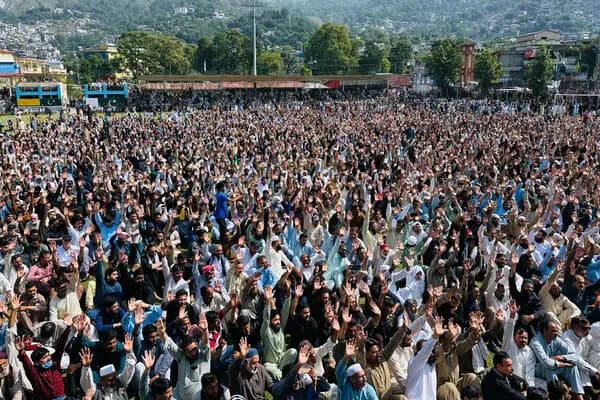
- Civil unrest in PoK has been fueled by demands for economic justice and political representation.
- The Joint Awami Action Committee (JAAC), formed in 2023, has led protests against rising electricity tariffs and inflation, presenting a 38-point Charter of Demands:
- Access to subsidised wheat flour.
- Fair electricity pricing tied to local hydropower costs.
- Abolishment of the 12 reserved seats for refugees in the PoK Legislative Assembly.
Government Response and Violence:
- The JAAC was banned for “engaging in terrorism” under a 2014 anti-terrorism law.
- Protests led to clashes resulting in at least 30 deaths and hundreds injured during police confrontations, especially notable clashes on June 8, which killed 11 individuals, including police officers.
- A compensation package of PKR 10 billion for electricity improvements was announced, along with funds for health card implementation.
Electoral Context:
- Elections for the PoK regional government are scheduled for July 27.
- The JAAC planned protests coinciding with the opening of nominations, specifically focusing on the discontent surrounding the 12 reserved refugee seats.
Key Statistics:
- PoK’s Legislative Assembly has 53 seats:
- 45 are directly elected (33 general public, 12 reserved for refugees).
- 8 seats reserved for women and technocrats, filled by nominations.
- The 12 reserved seats represent around 436,000 registered voters, while the other 33 seats represent about 3.3 million voters.
- PoK’s Legislative Assembly has 53 seats:
Constitutional References:
- The Supreme Court of PoK ruled that the 12 seats reserved for refugees are constitutionally protected, and any abolition requires a constitutional amendment.
International Concern and Reactions:
- India urged the international community to hold Pakistan accountable for alleged human rights abuses in PoK, citing police brutality during protests.
- Human rights organizations, including Amnesty International, condemned the crackdown on protests as indicative of worsening human rights conditions.
- British parliamentarians expressed concerns and urged diplomatic engagement to ease tensions.
Political and Social Dynamics:
- Despite claims of autonomy, Pakistan exerts political influence in PoK, requiring elected officials to affirm loyalty to the accession of Jammu and Kashmir to Pakistan.
- The situation reflects broader issues of representation, governance, and human rights within the region.
Government Schemes and Subsidies:
- An $86.25 million subsidy program was approved in response to ongoing protests.
- Regional authorities have increased security measures, deploying paramilitary troops to control unrest and implementing internet restrictions.
Conclusion:
- The protests in PoK underscore significant tensions over economic conditions, political representation, and broader human rights issues, with implications for regional stability and international relations.
Key Terms & Concepts
| Joint Awami Action Committee (JAAC) | Organized protests for demands |
| $86.25 million subsidy programme | Government financial assistance |
| PKR 10 billion | Funding for electricity improvement |
| 12 reserved seats for refugees | Political representation issue |
| 53 seats | Total seats in PoK Assembly |
| Supreme Court of PoK | Judicial authority on seats |
| June 9 | Day of planned protest march |
| June 7 | Supreme Court observation date |
| Amnesty International | Human rights organization |
| British parliamentarians | Voiced concerns on unrest |
| Electricity pricing based on hydropower | JAAC's demand for fairness |
| 40 lakh | Total registered voters in PoK |