iAspirants
Concerns Over Foreign Contribution Bill
Published on:
Share this post
Article Summary
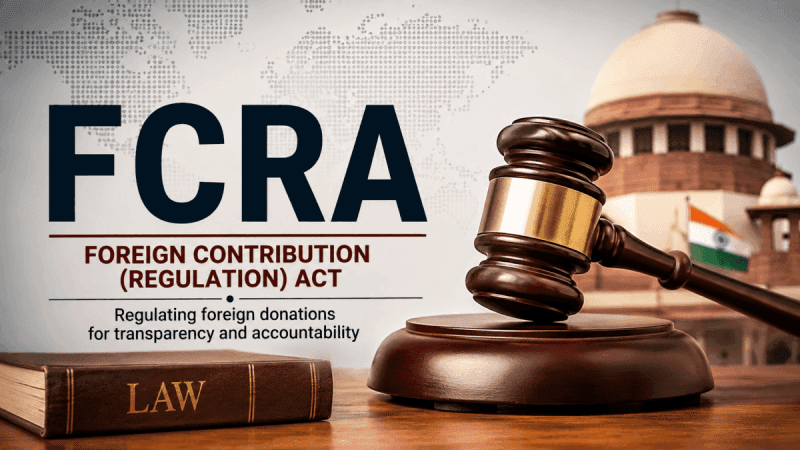
Summary of Key Points on the Foreign Contribution (Regulation) Amendment Bill, 2026 (FCRA)
Constitutional and Legal References:
- The FCRA Bill, 2026 is designed to regulate the receipt of foreign contributions by NGOs, with implications for minority rights as guaranteed under the Constitution of India.
- Concerns raised about potential violations of constitutional guarantees to minorities, including the right to manage religious places and properties.
Key Provisions of the FCRA Bill, 2026:
- Designated Authority: The Bill proposes the establishment of a designated authority with civil court powers to manage or dispose of assets created from foreign funds if an NGO's FCRA registration is suspended or canceled.
- Deemed Cessation of Assets: If an NGO's registration is not renewed, assets may be deemed to have ceased, raising concerns about the lack of judicial oversight in asset management.
- Non-Retrospective Application: Assurance given that the provisions will not apply retrospectively, addressing concerns about existing NGOs.
Government Assurance and Responses:
- Home Minister Amit Shah assured that the Bill is "religion-neutral" and aims to enforce law compliance, not to target any specific faith or community.
- Ongoing discussions with Christian community representatives to address their concerns, including potential repercussions on institutions that provide education and healthcare.
Delegation and Consultations:
- The delegation included members from various Christian denominations, who expressed the need for a comprehensive review of the FCRA Act introduced in 2010.
- Concerns about the Bill's implications for the operational stability of NGOs and their contributions to society were raised.
Economic and Operational Impact:
- Approximately 15% of total foreign donations in India are received by Christian NGOs, which play a crucial role in social services.
- The Bill's provisions may threaten the operational integrity of these organizations, impacting healthcare, education, and community development.
Government's Position and Future Steps:
- Government sources indicate that no further changes to the Bill are anticipated; however, specifics regarding the asset takeover process will be clarified in the forthcoming Rules.
- A detailed representation requesting the withdrawal of the Bill or referral to a Joint Parliamentary Committee for stakeholder consultation was submitted by the delegation.
Recent Developments:
- Previous meetings with state leaders, including the Chief Ministers of Mizoram and Meghalaya, highlighted similar concerns regarding the potential disruption to religious, educational, and charitable institutions.
- The importance of maintaining the religious character of places of worship was underscored in statements from the Press Information Bureau.
Conclusion:
The FCRA Bill, 2026 raises significant concerns among minority communities regarding its implications for their rights and operational capabilities. Ongoing discussions and assurances from the government indicate a need for careful consideration of the Bill's provisions to protect the interests of NGOs and the communities they serve.
Key Terms & Concepts
| Foreign Contribution (Regulation) Amendment Bill, 2026 | Proposed legislation affecting NGOs |
| FCRA | Regulates foreign funding for NGOs |
| August 12, 2026 | Discussion date in Parliament |
| March 25, 2026 | Bill introduction date in Lok Sabha |
| 15% | Percentage of foreign donations to NGOs |
| Joint Parliamentary Committee | Request for stakeholder consultation |
| designated authority | Manages assets of NGOs |
| July 22, 2026 | Press Information Bureau announcement date |
| Constitutional guarantees | Rights for minority communities |