iAspirants
Delhi High Court Hearing on Protests
Published on:
Share this post
Article Summary
Delhi High Court Rulings on Student Protests and Surveillance: Key Points
Background:
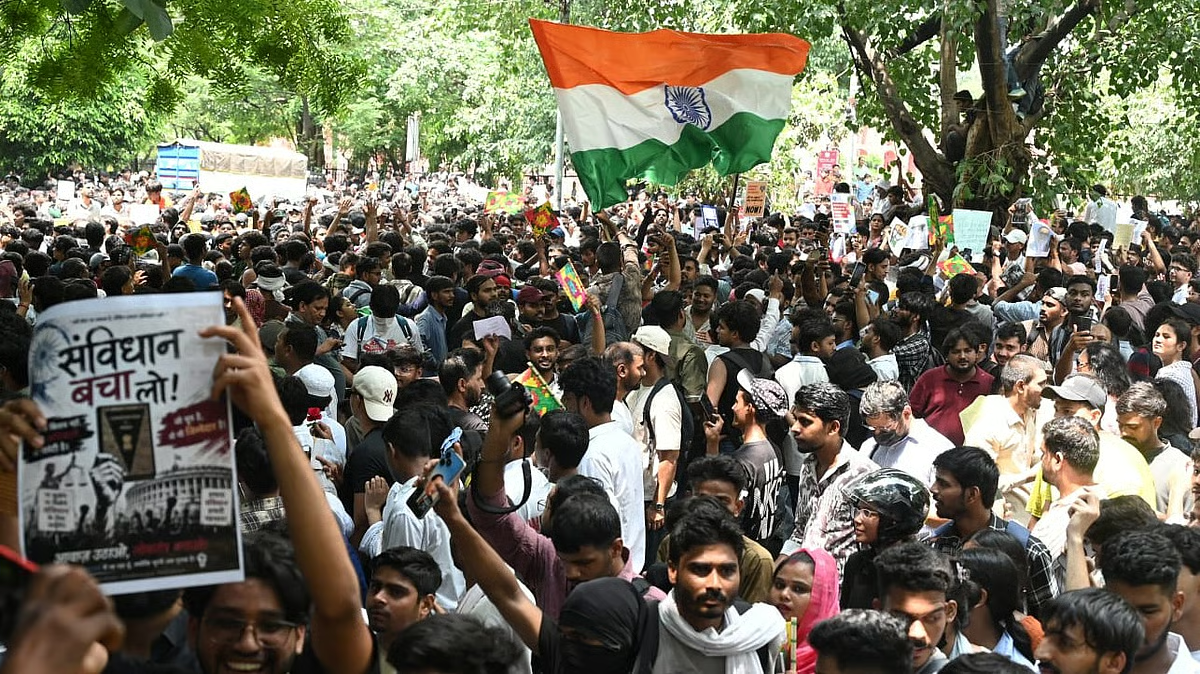
- Series of Public Interest Litigations (PILs) arose from student protests at Jantar Mantar concerning alleged NEET examination irregularities and a protest organized by the Cockroach Janta Party (CJP) on July 20, 2026.
- Protests included claims of police surveillance and excessive force against demonstrators.
Judicial Proceedings:
- Chief Justice D.K. Upadhyaya and Justice Tejas Karia presided over the hearings.
- The court declined to initiate a National Investigation Agency (NIA) probe into the protest incidents, stating that decisions about such referrals fall within the Central government’s jurisdiction.
- Emphasized that any FIR must first be filed, after which it can be escalated to NIA if warranted by the Central government.
Rights and Legal Arguments:
- Petitioners highlighted the impact of protests on fundamental rights, citing blocked roads and public transportation closures.
- Discussion around the fundamental right to privacy (protected under Article 21 of the Constitution), as raised by petitioners regarding alleged police surveillance techniques used on protestors, particularly minors.
- Senior Advocate Nandita Rao argued that police use of surveillance might not satisfy legal standards for privacy under constitutional scrutiny.
Police Surveillance:
- Allegations of continuous videography and facial recognition technology deployment against protesters, raising concerns about legality and privacy rights.
- Solicitor-General Tushar Mehta countered that videography of public protests is standard practice, arguing that privacy expectations in public demonstrations are minimal.
Court Observations:
- The court noted that it would not adjudicate on factual matters of the protest but would focus on legal frameworks.
- Stressed the need for competent authority investigations into claims of mob violence and destruction of public property based on previous Supreme Court judgments.
Outcome of the Hearings:
- The petition seeking an NIA investigation was dismissed, allowing the petitioner to approach appropriate authorities for grievances regarding public property damage and police conduct.
- Another petition challenging surveillance was scheduled for further hearing, with the court urging formal articulation of privacy concerns.
Constitutional References:
- Mentioned rights under Article 21 related to privacy.
- Established principles from Supreme Court rulings on mob violence and public protests.
Government Response:
- The court suggested that authorities should effectively manage incidents according to established legal precedents.
Future Considerations:
- Continuation of PILs focusing on the balance between state surveillance for public safety versus individual rights in protests.
- The legal landscape around technological surveillance in public demonstrations remains contentious and is likely to evolve with upcoming hearings.
This summary encapsulates the key judicial decisions and legal principles emerging from the recent Delhi High Court proceedings concerning student protests and state surveillance, highlighting the interplay between public safety, individual rights, and constitutional mandates.
Key Terms & Concepts
| Delhi High Court | Judicial authority overseeing petitions |
| Public Interest Litigations (PILs) | Legal petitions for court review |
| National Investigation Agency (NIA) | Request for investigative authority |
| Chalo Sansad march | Student protest event |
| Supreme Court | Highest court reference for principles |
| Facial recognition technology | Used for surveillance of protesters |
| Save India Foundation | Petitioner regarding public property issues |
| Constitutional right to privacy | Basis for legal argument |
| July 24, 2026 | Date of court hearing |
| Akhil Bharat Hindu Mahasabha | Political organization linked to petition |