iAspirants
Discovery of Free-Floating Rogue Planet
Published on:
Share this post
Article Summary
Summary of Astronomical Discovery of Free-Floating Planet
Discovery Details:
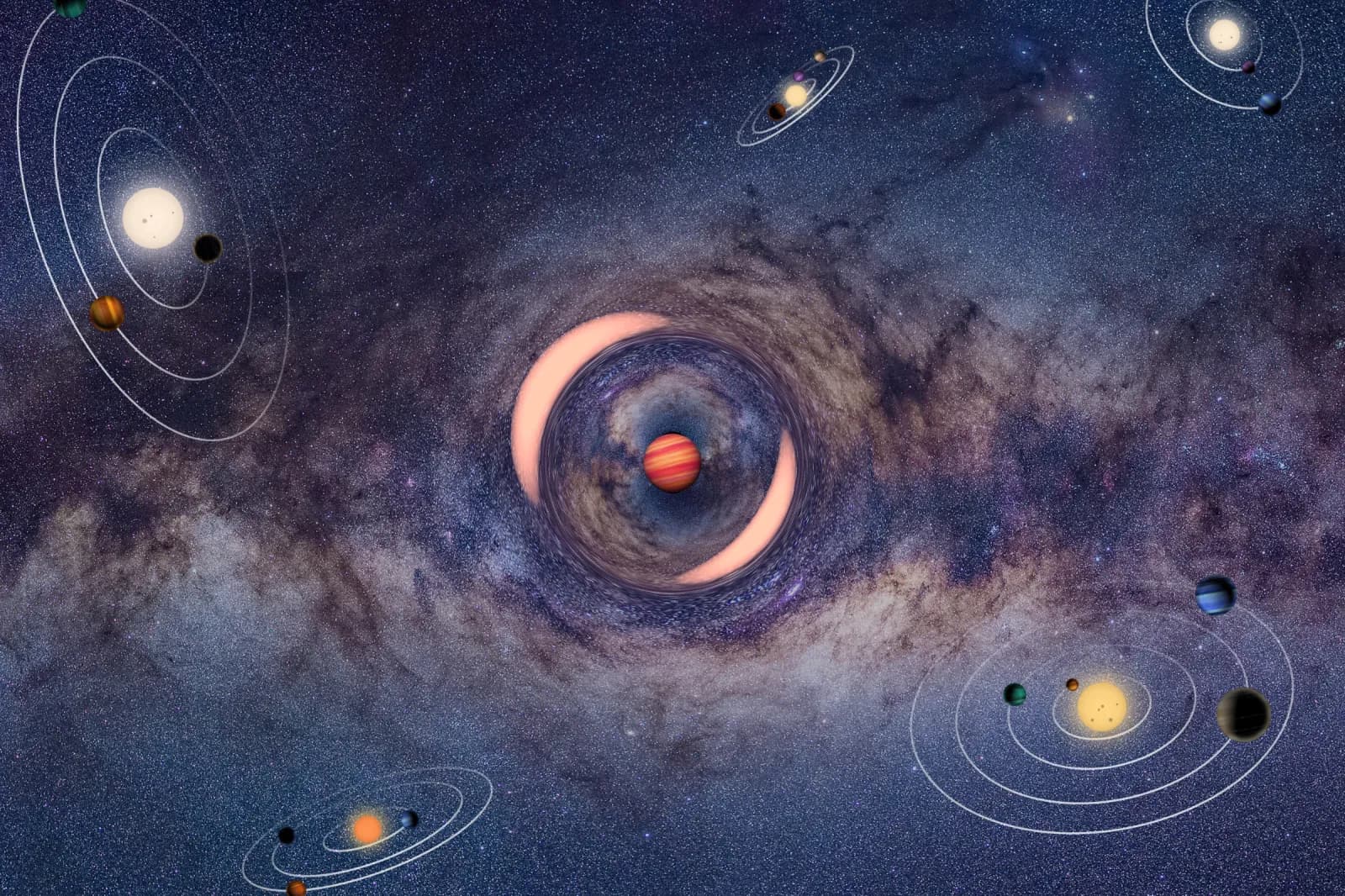
- Astronomers have confirmed a “free-floating” planet approximately 9,950 light-years from Earth, roughly the size of Saturn.
- This planet is categorized as a rogue planet, meaning it does not orbit any star.
- The discovery highlights that such planets could be more common in the Milky Way than previously thought.
Methodology:
- The planet was detected through gravitational microlensing, a technique that involves observing distortions in the light from a distant star when the planet passes in front, causing a magnifying effect.
- This method allowed scientists to determine the planet's distance and mass accurately, marking a first for rogue planet detection.
Mass Estimates:
- The rogue planet has an estimated mass of about 70 times that of Earth.
Theoretical Significance:
- The findings support theoretical models suggesting that planets can be ejected into interstellar space due to gravitational interactions during the formation of planetary systems. Some may even form in isolation similar to stars.
Future Exploration:
- Upcoming astronomical missions include:
- NASA's Nancy Grace Roman Space Telescope: Scheduled to launch in 2026, aims to conduct rapid surveys of extensive regions of the galaxy.
- China's Earth 2.0 mission: Planned to search for free-floating planets later in the decade.
Publications:
- The findings have been published in the journal Science, indicating a significant step in understanding the distribution and evolution of celestial bodies beyond traditional star systems.
Key Points for Examination:
- Rogue planets: Definition and characteristics.
- Gravitational microlensing: Explanation and significance in planetary discovery.
- Mas and distance calculations: Importance in the detection of celestial objects.
- Future missions: NASA and China's space projects aimed at exploring the galaxy.
- Theoretical implications: Insights into planetary system formation and the existence of interstellar objects.
These insights offer an expanded understanding of the dynamics of the cosmos, potentially reshaping existing paradigms regarding planet formation and distribution.
Key Terms & Concepts
| 9,950 light-years | Distance from Earth |
| 70 times that of the Earth | Mass of the rogue planet |
| European Space Agency’s Gaia | Mission used for observation |
| Gravitational microlensing | Technique for detection |
| Nancy Grace Roman Space Telescope | Upcoming space observatory |
| Earth 2.0 mission | China's upcoming mission |
| January 1 | Publication date of findings |
| journal Science | Publication platform |