iAspirants
Discovery of Rare Bow-Shaped Galaxy
Published on:
Share this post
Article Summary
Exam-Focused Notes on Discovery of RAD-BAARG
Discovery Details:
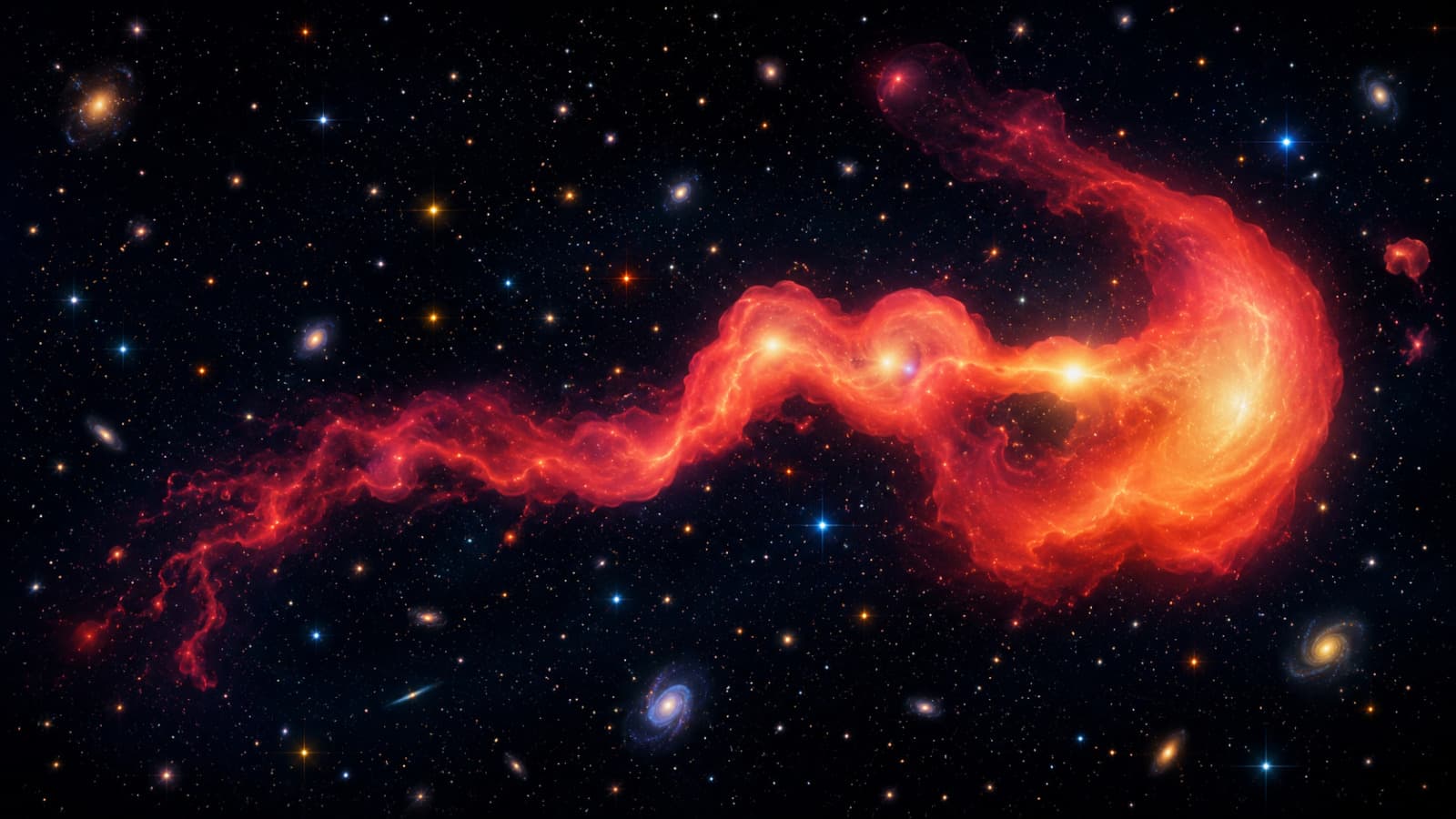
- RAD-BAARG: Newly discovered radio galaxy shaped like a bow and arrow, approximately 1.8 million light years wide, located 2 billion light years from Earth.
- Significance: It's a type of active galaxy powered by supermassive black holes, emitting high amounts of energy as radio waves.
- Research Publication: Findings published in the Monthly Notices of the Royal Astronomical Society on June 22.
- Research Team: Comprised of 12 Indian researchers from institutions such as the University of Mumbai and the National Centre for Nuclear Research, among others.
Characteristics of RAD-BAARG:
- Asymmetrical Structure: Unlike any standard radio galaxy, displaying a complex morphology consistent with interactions between radio jets and cosmic structures.
- Bow-Shock Interaction: The structure suggests interaction with a shock front caused by the host galaxy moving through surrounding hot gas towards a cluster of galaxies.
- External Views: Observed using LOFAR (Low Frequency Array), confirming the presence of faint, low-surface-brightness emissions.
Key Terms:
- Kpc: Kiloparsec (1 kpc = 3,260 light-years).
- Infall: Movement of gas or cosmic bodies towards a massive object due to gravity.
Implications for Future Research:
- Expected developments in radio astronomy with next-generation facilities like the Square Kilometre Array Observatory (currently under construction).
- Potential application of Artificial Intelligence and machine learning to discover more unusual radio galaxies from large data volumes anticipated from future surveys.
Quotes from Researchers:
- Ananda Hota (Lead Author): Noted the unique morphology suggests strong interaction phenomena which have been hard to detect directly due to diffuse gas surroundings.
- Shubhrangshu Ghosh: Highlighted the structure's interaction with the surrounding environment, akin to shock waves produced from supersonic movement.
Conclusion:
RAD-BAARG presents a rare discovery in the field of astronomy and underscores the importance of advanced observational techniques. Its findings contribute significantly to our understanding of the complexities of galaxy interactions and the behavior of cosmic structures.
Key Terms & Concepts
| RAD-BAARG | Newly discovered radio galaxy |
| 1.8 million light years | Size of RAD-BAARG |
| 2 billion light years | Distance from Earth |
| 560 kpc | Bow-shock structure size |
| RAD@home Astronomy Collaboratory | Citizen science research platform |
| LOFAR | Low Frequency Array used for discovery |
| Monthly Notices of the Royal Astronomical Society | Journal of published research |
| June 22 | Publication date |
| Square Kilometre Array Observatory | Future astronomical facility |
| Artificial Intelligence | Proposed for identifying galaxies |
| Machine learning | Proposed for data analysis |