iAspirants
End of New START Treaty Insights
Published on:
Share this post
Article Summary
Summary of Key Points on the Expiry of the New START Treaty
Context
- Date of Expiry: February 5, 2026.
- Significance: Marks the end of over five decades of bilateral nuclear arms control agreements between the US and Russia, raising concerns for global peace and security.
International Response
- UN Secretary-General Antonio Guterres: Called it a "grave moment" highlighting it as the first occasion in over 50 years without binding limits on the nuclear arsenals of the US and Russia.
Historical Background
Cold War Agreements and Arms Control Initiatives:
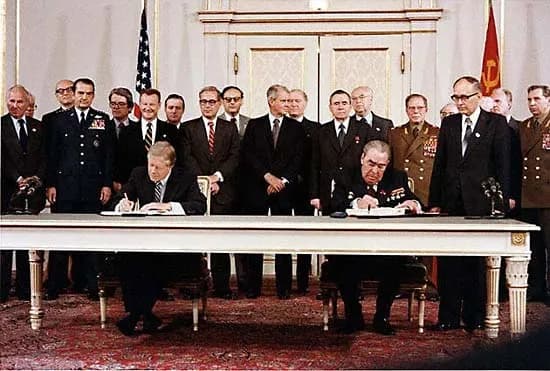
- SALT Talks (1969): Aimed to curtail the arms race, resulting in:
- ABM Treaty (1972): Limited each side’s strategic missile defenses.
- SALT II (1979): Proposed limits on ICBMs and missile systems but was not ratified due to geopolitical tensions.
- SALT Talks (1969): Aimed to curtail the arms race, resulting in:
Post-Cold War Treaties:
- START I (1991): Required reductions to 1,600 strategic arsenals and 6,000 warheads, implemented intrusive verification methods.
- START II (1993): Aimed for further reduction but never came into force because of delays and unilateral withdrawals.
- SORT (2002): Focused on reducing warheads to 1,700-2,200, followed by the establishment of New START.
New START Treaty (2010):
- Limited strategic warheads to 1,550 and allowed for inspections to ensure compliance.
- Extended in 2021 for an additional five years until February 2026.
Current Situation
- Post-Treaty Conditions:
- The expiry eliminates legal limits on nuclear arsenals, with the US possessing approximately 5,277 warheads and Russia about 5,449 as per 2025 estimates.
Implications and Concerns
- Potential for Arms Race: Analysts caution the risk of a renewed arms race due to the absence of formal limits.
- Broader Security Risks: Increasing tensions involving regional conflicts with China and Russia may provoke arms competition.
- Expert Opinions:
- Reports suggest the importance of preventing inadvertent escalation and maintaining some level of transparency regarding Russia’s arsenal.
- The Strain on nuclear deterrence frameworks could destabilize global security dynamics.
Upcoming International Events
- Nuclear Non-Proliferation Treaty (NPT) Review Conference (2026): Critical for nuclear-armed states to show progress on disarmament and restraint.
Conclusion
The expiry of the New START Treaty is a critical juncture in international arms control, raising alarms about potential destabilization in global security frameworks. The global community is urged to reevaluate and potentially reimagine arms control mechanisms to adapt to the evolving security landscape.
Key Terms & Concepts
| New START Treaty | Last nuclear arms control treaty |
| SALT Agreements | Cold War arms control talks |
| START I & II | Post-Cold War reduction treaties |
| Strategic Offensive Reductions Treaty (SORT) | Reduced warhead limits |
| February 5, 2011 | New START Treaty start date |
| February 5, 2026 | Expiry of New START Treaty |
| 5,277 warheads (US) | US nuclear arsenal estimate |
| 5,449 warheads (Russia) | Russia nuclear arsenal estimate |
| 2016 Review Conference | Future nuclear disarmament review |
| UN Secretary-General Antonio Guterres | Comment on treaty expiry |
| Bulletin of the Atomic Scientists | Research on nuclear risks |