iAspirants
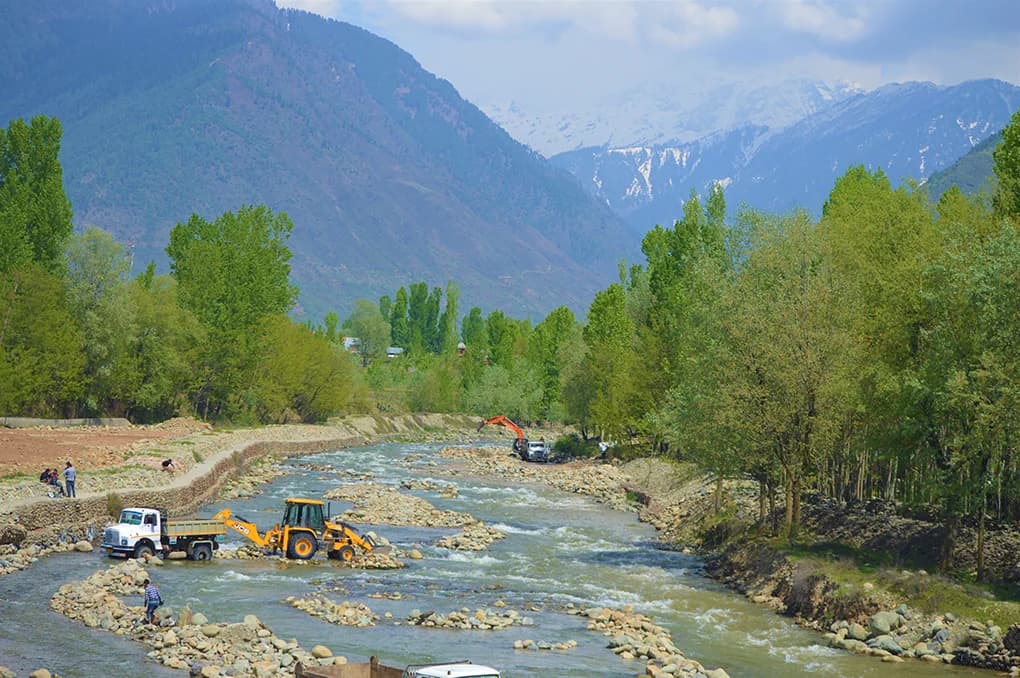
Environmental Impact of Mining in Kashmir
Published on:
Share this post
Article Summary
Summary of Key Facts and Data
Location and Environmental Impact:
- Village: Sail, Budgam district, Kashmir.
- Population: Approximately 2,500 residents.
- River: Sukhnag River, a 54-km tributary of Jhelum, critical for drinking water, irrigation, and trout fishing.
- Ecological Changes:
- Evidence of severe mining impacts includes deep excavation below the riverbed, with depths recorded at 4.42 meters (nearly 15 feet).
- Loss of aquatic life and lowered water tables leading to barren agricultural fields.
Government Actions and Environmental Regulations:
- Concerns Raised: A report by a joint panel of the Ministry of Environment, Forest and Climate Change (MoEF&CC), National Institute of Himalayan Environment (NIHE), and Jammu and Kashmir Pollution Control Committee (JKPCC) highlighted unscientific mining practices.
- Legal Proceedings: A report was submitted to the National Green Tribunal (NGT) highlighting considerable hydrogeological damage and recommending a moratorium on all mining activities.
- Permits Issued: The local district administration issued 148 short-term permits allowing for the extraction of approximately 437,000 metric tonnes of riverbed materials, predominantly to NKC Projects Pvt. Ltd.
Judicial Rulings:
- NGT Involvement: The National Green Tribunal intervened following environmental petitions, leading to investigations in January of the previous year.
- Supreme Court Endorsement: The NGT’s orders regarding mining regulation were upheld by the Supreme Court in August 2025, emphasizing the need for compliance with environmental laws.
Economic Implications:
- Agricultural Losses: Residents like Imtiyaz Ali reported a shift from profitable paddy farming to planting acacia trees due to water scarcity. Previously, a 10 kanals land yielded 50 quintals of paddy valued at Rs 3,000/quintal.
- Financial Disparity: The cost paid by NKC Projects for mining operations was less than Rs 1 crore, significantly below the value of extracted materials.
Environmental Rights and Community Response:
- Activism: Residents faced intimidation for protesting against the mining activities, and some have sought legal protection.
- Community Development Risks: The degradation of the Sukhnag river is impacting livelihoods, particularly in agriculture and trout farming.
Recommendations and Observations
- Moratorium Enforcement: Immediate suspension of all mining operations in the Sukhnag River area until ecological restoration is achieved.
- Policy Review: Reevaluation of short-term permit issuance processes to ensure stricter adherence to environmental clearance regulations.
- Community Engagement: Strengthening local community involvement in monitoring and protecting water resources to preempt further ecological damage.
- Long-term Environmental Studies: Initiation of comprehensive studies to assess the cumulative effects of mining on local ecosystems and water resources.
Conclusion
There is a critical need for environmental preservation in the Sukhnag River region. Continued oversight by authorities and community participation are essential to reverse ecological damage and support the livelihoods of local residents.
Key Terms & Concepts
| Sukhnag River | Key water source in Budgam |
| Budgam District | Location affected by mining |
| MoEF&CC | Government body overseeing environment |
| National Green Tribunal | Judicial authority for environmental issues |
| G B Pant National Institute of Himalayan Environment | Research entity measuring extraction |
| NKC Projects Pvt. Ltd. | Company involved in mining |
| 148 short-term permits | Permits issued for mining |
| Rs 1 crore | Income from mining permits |
| 4,37,000 metric tonnes | Materials extracted under permits |
| Supreme Court guidelines | Legal standards for mining |
| 10.6 lakh to 15.3 lakh tonnes | Estimated extraction volume |
| 3.86 metres | Conservative depth of extraction |