iAspirants
Great Nicobar Project Strategic Development
Published on:
Share this post
Article Summary
Great Nicobar Project: Strategic Importance and Sustainable Development
Objectives
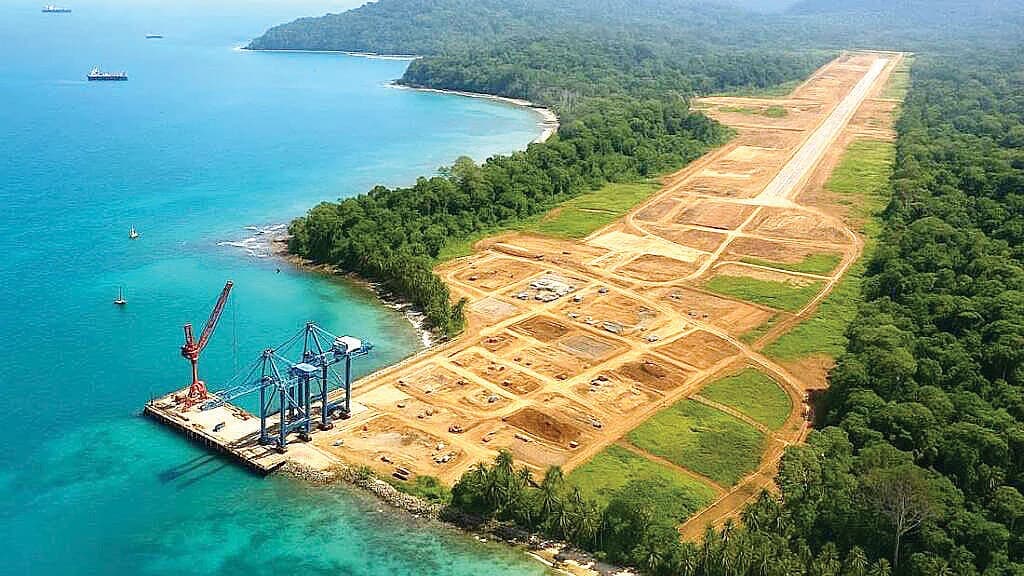
- Transform Great Nicobar Island into a strategic maritime and economic hub.
- Reduce dependence on foreign transshipment ports and enhance India’s maritime security.
Key Infrastructure Components
International Container Transshipment Terminal (ICTT):
- Capacity: 14.2 million Twenty-foot Equivalent Units (TEUs).
- Located near East-West shipping routes (40 nautical miles away).
- Aims to reduce reliance on Colombo and Singapore for cargo shipping.
Greenfield International Airport:
- Capacity: 4000 peak hour passengers.
- Expected to serve at least 1 million passengers at opening, with a future target of 10 million.
Hybrid Power Plant:
- Capacity: 450 Megavolt Amperes (MVA) using gas and solar energy.
- Designed to ensure continuous power supply and disaster resilience.
Planned Township:
- Development to meet residential, commercial, and institutional needs arising from port-based growth.
Environmental Framework
- The project adheres to the Environmental Impact Assessment (EIA) Notification 2006 and the Coastal Regulation Zone (CRZ) Notification 2019.
- Approval includes 42 compliance conditions to minimize environmental impact.
- Only 1.82% of forest cover will be diverted, with 97.30 square km earmarked for compensatory afforestation.
- Environmental Management Plan (EMP) established to mitigate ecological impacts.
Tribal Welfare
- No displacement of local tribes (Shompens and Nicobarese) is proposed.
- The project aligns with the provisions of Article 338A(9) of the Constitution, focusing on the protection of Scheduled Tribes' interests.
- 751.070 square km designated as tribal reserve area, with plans for compensatory increase in tribal reserve land.
Phased Implementation
- Phase I (2025-35): 72.12 sq km.
- Phase II (2036-41): 45.27 sq km.
- Phase III (2042-47): 48.71 sq km.
- Total area: 166.10 sq km, including 35.35 sq km of revenue land and 130.75 sq km of forest land.
Risk Assessment and Disaster Management
- Comprehensive risk assessment for natural disasters (tsunamis, earthquakes, cyclones) and industrial risks.
- Disaster management plan to enhance preparedness.
Economic Significance
- The project is expected to strengthen India’s national security and economic position in the Indian Ocean Region (IOR).
- Aims to create a balance between infrastructure development, environmental conservation, and tribal welfare.
Conclusion
- The Great Nicobar Project exemplifies an integrated approach to development, emphasizing economic growth while ensuring environmental sustainability and tribal rights.
- It aims to serve as a model for future infrastructure projects in ecologically sensitive areas, demonstrating that economic development can coexist harmoniously with environmental stewardship.
Key Terms & Concepts
| Great Nicobar Project | Strategic maritime and economic center |
| International Container Transshipment Terminal | 14.2 million TEU capacity terminal |
| Greenfield International Airport | 4000 peak hour passenger capacity |
| 450 MVA Gas-Solar Power Plant | Hybrid energy source for operations |
| EIA Notification 2006 | Environmental clearance requirement |
| ICRZ Notification 2019 | Coastal regulation compliance |
| 42 compliance conditions | Mandatory for project approval |
| 1.82% forest cover diversion | Minimal environmental impact plan |
| 97.30 sq km compensatory afforestation | Reforestation plan for impact balance |
| Scheduled Tribes and Other Traditional Forest Dwellers Act | Protection of tribal rights |
| Article 338A(9) of Constitution | Protection of tribal interests |
| 3 monitoring committees |