iAspirants
Impact of US Tariff on India Pharma
Published on:
Share this post
Article Summary
Key Facts and Data
U.S. Tariff Announcement:
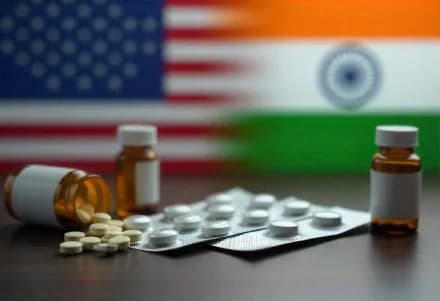
- Effective from October 1, 2025, the U.S. imposed a 100% tariff on branded and patented pharmaceutical imports.
- This move is intended to boost domestic manufacturing.
Impact on Indian Pharmaceutical Industry:
- India's pharmaceutical exports to the U.S. reached nearly $9 billion in fiscal 2025 (14.29% increase year-on-year).
- The Indian pharmaceutical sector is valued at $50 billion, contributing approximately 1.72% to India's GDP.
Global Pharmaceutical Market:
- Global pharmaceutical exports were valued at over $850 billion in 2024.
- Leading exporters included Germany, Switzerland, and the U.S. with significant import figures.
Export Dynamics:
- India is the third-largest exporter by volume with $30.47 billion in exports for FY25.
- Generics constitute 70% of India's exports to the U.S. and Europe.
Dependency and Supply Chain Risks:
- India imports approximately $5 billion worth of APIs annually, with 72% sourced from China.
- Potential tariff escalation could trim India's GDP growth by 0.2%-0.3% in FY26 if generics are included.
Economic Indicators
Sector Growth:
- The pharmaceutical sector has a projected growth rate of 10%-12% CAGR, adding 0.5%-1% to GDP growth annually.
- The goal for India's pharma market is to reach $130 billion by 2030.
- Forecasts project global pharmaceutical spending to hit $1.5 trillion by 2029.
GST Reforms:
- From September 22, 2025, GST on drugs reduced from 12% to 5%, which translates to annual savings of $1.2 billion for consumers.
Government Schemes and Policies
Pradhan Mantri Bhartiya Janaushadhi Pariyojana (PMBJP):
- 16,912 Jan Aushadhi Kendras established by June 2025.
- Aimed to provide affordable medicines and medical supplies, with significant reductions in treatment costs (70% for oncology medications).
Production Linked Incentive (PLI) Scheme:
- Aims to reclaim 20% of domestic production; $10 billion earmarked for API investments under PLI 2.0.
International Relations and Agreements
- Recent MoUs:
- Six agreements signed with Trinidad and Tobago related to pharmaceuticals.
- MoUs with Singapore for API cooperation, enhancing cross-border pharma collaboration.
Challenges and Future Outlook
- Quality Concerns: Quality issues and supply chain disruptions could delay treatments significantly.
- Market Strategy: The need for "China-plus-one" strategies encourages exploring new markets in Africa and Southeast Asia.
- Risk Mitigation: To safeguard against tariff risks, India must enhance diplomatic ties and ramp up API production.
- Growth Potential: India’s regulated market share for pharmaceuticals is expected to increase from 3% to 3.5% by 2030.
International Agreements and Context
- U.S.-EU Pact:
- Prioritizes supply chain security concerning medicinal product exports to the U.S.
Environmental and Health Indicators
- Healthcare Affordability: Risks in healthcare costs due to tariffs, potentially raising treatment prices for U.S. cancer therapies significantly.
This summary serves to provide an overview of the recent developments in the pharmaceutical sector, including economic implications, government initiatives, and the international landscape impacting India's pharmaceutical exports and manufacturing capabilities.
Key Terms & Concepts
| 100% tariff | Imposed on pharmaceutical imports |
| $9 billion | Pharma exports to U.S. FY25 |
| $50 billion | India's pharmaceutical sector value |
| $850 billion | Global pharmaceutical exports in 2024 |
| €313.4 billion | EU medicinal exports in 2024 |
| 40% | India's share of U.S. generics |
| $219 billion | Savings for U.S. payers in 2022 |
| CAGR 10%-12% | Sector growth rate |
| $1.2 billion | Annual consumer savings from GST |
| Ayushman Bharat | Government health initiative |
| 16,912 | Jan Aushadhi Kendras opened |
| PMBJP | Pradhan Mantri Bhartiya Janaushadhi Pariyojana |
| $450 billion |