iAspirants
Implementation of National Credit Framework
Published on:
Source: PIB
Share this post
Article Summary
National Credit Framework (NCF) Implementation and Impact
Background:
- The National Education Policy (NEP) 2020 aims to provide holistic, multidisciplinary, flexible, and student-centric education.
- It promotes the integration of vocational education and envisions a comprehensive National Skill Qualification Framework (NSQF).
National Credit Framework (NCF):
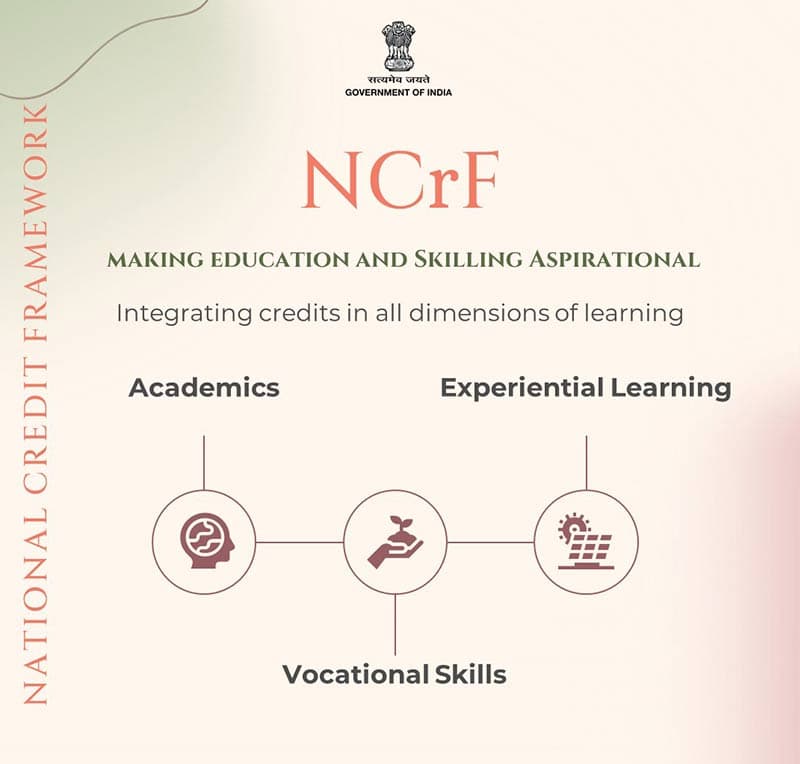
- Approved as a broad credit framework encompassing early, school, higher, and vocational education.
- Facilitates the conversion of learning-based activities into credits, with provisions for credit assessment, storage, transfer, and utilization.
- Establishes academic equivalence between skill-based and experiential education, enabling mobility within and between these domains.
Adoption and Implementation:
- As per the All India Survey on Higher Education (AISHE) 2023-24, over 700 universities and more than 7,500 affiliated colleges have adopted the NCF.
- The University Grants Commission (UGC) has notified a Standard Operating Procedure (SOP) for the operationalization of the NCF in higher education.
Key Provisions:
- Under the SOP, a maximum of 50% of the total credits for any program can be earned through skill-based courses.
- The All India Council for Technical Education (AICTE) has set eligibility criteria for technical programs in its Approval Process Handbook (APH) 2023-27, allowing students who have completed Class 10 and a two-year ITI to enter the second year of diploma courses in engineering and technology.
Recognition of Prior Learning (RPL):
- The National Council for Vocational Education and Training (NCVET) has developed guidelines for RPL, enabling industrial bodies to assess their workforce according to RPL criteria.
- This enhances the assessment process to align with industry needs.
Educational Outcomes:
- Credits are awarded based on specific skills, competencies, and learning outcomes.
- The Gross Enrollment Ratio (GER) in higher education has increased from 23.7% in 2014-15 to 30% in 2023-24.
- The GER for women rose from 22.9% to 31.2% during this period.
- Total enrollment in higher education increased from 34.2 million in 2014-15 to 45 million in 2023-24, adding over 10.8 million students to the higher education system.
Vision of NEP 2020:
- NEP 2020 envisions an education system rooted in Indian values and traditions that provides quality education to all, contributing to a just and vibrant knowledge society.
- The NCF aims to establish equivalence and mobility between general and skill education, promoting lifelong learning, recognition of prior learning, multiple entry and exit points, and continuous professional development.
Government's Commitment:
- The efforts of the government are geared towards enhancing the quality and accessibility of higher education, reflecting a direct response to the objectives outlined in the NEP 2020.
Ministerial Statement:
- The information was provided by the Union Minister of State for Education, Dr. Sukant Majumdar, in a written response in the Lok Sabha.
Key Terms & Concepts
| National Education Policy (NEP) 2020 | Framework for holistic education |
| National Skill Qualification Framework (NSQF) | Integration of skill education |
| National Credit Framework (NCRF) | Comprehensive credit system |
| All India Survey on Higher Education (AISHE) 2023-24 | Data on university adoption |
| University Grants Commission (UGC) | Guidelines for NCRF implementation |
| Gross Enrollment Ratio (GER) | Indicator of higher education access |
| National Council for Vocational Education and Training (NCVET) | Guidelines for prior learning recognition |
| Skill-based courses | Max 50% credits from these |
| 10th grade and ITI | Eligibility for diploma courses |
| 2014-15 to 2023-24 | Timeframe for GER increase |
| 1.08 crore | Increase in higher education enrollment |