iAspirants
India Revises GDP Data Series Methodology
Published on:
Share this post
Article Summary
Exam-Focused Notes on India's GDP Data Series Revision
Ministry of Statistics and Programme Implementation (MoSPI) Initiatives:
- Revised GDP Estimation: MoSPI plans to revise the GDP data series by eliminating the 'discrepancies' component, which has historically clouded economic analysis.
- New Base Year: The new series of GDP estimates will adopt the base year 2022-23, with a planned release date of February 27, 2026.
- GDP Back Series: The back series data corresponding to the revised base year is expected to be published by February 2027.
Understanding Discrepancies in GDP Calculations:
- Methods of GDP Calculation:
- Production/Income Approach: Aggregation of value-added across sectors such as manufacturing, services, and agriculture.
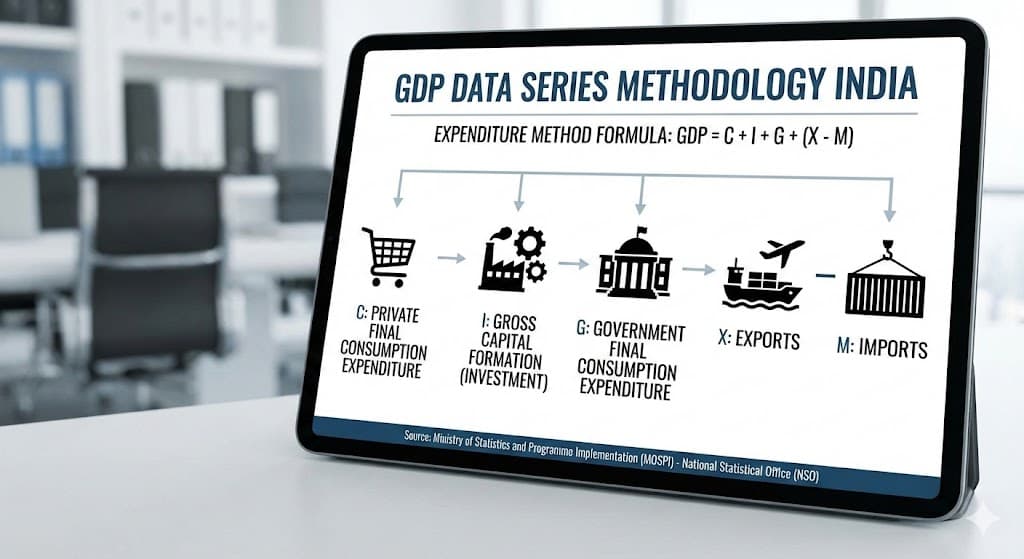
- Expenditure Approach: Totaling consumption and investment expenditures.
- Nature of Discrepancies: Discrepancies arise due to inconsistencies in data sources, coverage, valuation, and data lags, impacting GDP estimates.
- Positive Discrepancies: Indicate production approach GDP (higher) vs. expenditure approach GDP (lower).
- Negative Discrepancies: Indicate expenditure approach GDP (higher) vs. production approach GDP (lower).
Recent Economic Indicators:
- GDP Growth Rate: A notable growth of 8.2% (real terms) in the economy for the quarter of July-September, accompanied by discrepancies of Rs 1.63 lakh crore (3.3% of GDP).
- Nominal Discrepancies: The nominal discrepancy for the same period was reported at negative Rs 2.46 lakh crore (-2.9% of GDP).
Impact of Discrepancies on Economic Analysis:
- Volatility of Discrepancies: Historical data shows significant fluctuations in discrepancies, as evidenced by a positive 3.3% in July-September versus a negative 3% in January-March 2023.
- Challenges of Accurate GDP Calculation: Issues stem from reliance on outdated survey data and the complex nature of economic measurements.
Future Enhancements in GDP Data Collection:
- Integration of Supply and Use Tables: MoSPI aims to utilize comprehensive supply and use tables for enhanced accuracy in GDP estimates, ensuring a balance between supply and use of goods and services.
- Objective: The goal is to limit discrepancies in early estimates and eliminate them in the final accounting stage.
Expert Insights:
- Commentators emphasize that while the removal of discrepancies would be beneficial, challenges in accurately calculating GDP persist, particularly related to the reliance on older data and methodological constraints.
Conclusion: The revision of India's GDP data methodology is aimed at fostering greater clarity and accuracy in economic reporting, with the significant procedure changes set to be rolled out by 2026 and ongoing adjustments into 2027. The economic implications of these revisions will be closely monitored, given their impact on policy formulation and economic stability.
Key Terms & Concepts
| Ministry of Statistics and Programme Implementation | Overseeing GDP data revision |
| Base Year: 2022-23 | New baseline for GDP calculation |
| February 27, 2026 | Launch date for new GDP series |
| GDP discrepancies | Conflicting GDP calculation results |
| 3.3 percent of GDP | Magnitude of July-September discrepancies |
| System of National Accounts (SNA) | Framework for GDP data |
| Supply and use tables | Integrating supply data in GDP |
| Rs 1.63 lakh crore | Amount representing GDP discrepancies |
| 2023 COVID-19 Pandemic | Impact on GDP discrepancies |