iAspirants
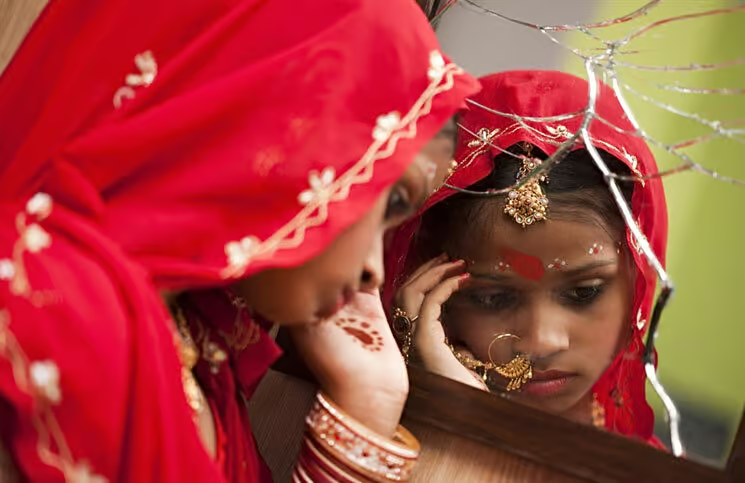
India's Commitment to End Child Marriage
Published on:
Share this post
Article Summary
Summary Notes on Child Marriage in India
Constitutional References and Legal Framework:
- Prevention of Child Marriage Act, 2006: Primary legislation aimed at prohibiting child marriages in India. However, its application is infrequent and convictions are low.
- Protection of Children from Sexual Offences Act (POCSO): Serves to protect children from sexual abuse but may inadvertently push underage girls towards unregistered help due to fear of legal repercussions.
Government Schemes and Initiatives:
- Bal Vivah Mukt Bharat Abhiyan: Launched by the Union government as part of efforts to eradicate child marriage by 2030, in alignment with the UN’s Sustainable Development Goals (SDGs).
- Beti Bachao Beti Padhao: A campaign aimed at promoting girls' education and welfare, though its effectiveness is questioned, particularly in vulnerable communities.
Statistical Data on Child Marriage:
- Child Marriage Rates:
- Reduction from 47.4% in 2005-06 to 23.3% in 2019-21 (NFHS data).
- Significant variations in states:
- Highest rates observed in West Bengal, Bihar, and Tripura.
- Socio-economic Correlation:
- 40% of girls from the lowest wealth quintile married before adulthood vs. 8% from the highest quintile.
- 48% of girls with no education married below 18 years vs. 4% among those with higher education.
Challenges and Inequalities:
- Persisting child marriage is closely linked with poverty, education, and gender inequality.
- Infrastructure barriers, such as lack of safe public transport and clean toilets, hinder girls' access to education.
International Commitments:
- Closure of child marriage is crucial for achieving at least nine of the 17 SDGs, emphasizing the interconnection between child marriage and broader global development goals.
Needs for Improvement:
- Greater outreach and effectiveness of programs targeting vulnerable communities are essential.
- Assessment of the efficacy of incentives like cash schemes in states with high child marriage rates.
Key Takeaways:
- The incidence of child marriage in India, while decreasing, remains a significant and uneven issue across various states.
- Multi-faceted approaches that tackle poverty, education, and gender disparities are essential to eliminate child marriage effectively.
- Legal frameworks must be supported by community-based interventions that address underlying social issues.
Key Terms & Concepts
| Sustainable Development Goals (SDG) | Target to end child marriage by 2030 |
| Bal Vivah Mukt Bharat Abhiyan | Government campaign against child marriage |
| National Family Health Survey (NFHS) | Source of child marriage statistics |
| Prevention of Child Marriage Act, 2006 | Legal framework to end child marriage |
| Protection of Children from Sexual Offences Act | Law addressing child sexual offenses |
| Beti Bachao Beti Padhao | Government campaign for girls' welfare |
| Girls Not Brides | Global partnership against child marriage |
| 146 crore | Population of India |
| 40% and 8% | Comparative marriage rates by wealth |
| 48% and 4% | Marriage rates by education level |