iAspirants
HomeAbout UsCurrent AffairsPrelims PYQsPricing
iAspirants
HomeAboutBlogsFAQsPricingLogin
Privacy PolicyTerms & ConditionsReturn PolicyContact Us

© 2025 iAspirants, Inc. All rights reserved.

  1. Blogs
  2. National and International Importance

India's Defence Sector Modernization Efforts

Published on: 15-Aug-2026

Share this post

India's Defence Sector Modernization Efforts

Article Summary

Defence Sector Updates - Key Points

Government Priorities and Initiatives:

  • The Indian government prioritizes modernizing armed forces and creating a self-reliant defence sector.
  • Strategic initiatives such as ‘Aatmanirbhar Bharat’ and ‘Make in India’ have been fundamental in transforming the defence production landscape.

Statistics and Data:

  • Defence Production Growth: Increased from ₹46,000 crore in 2014 to ₹1.78 lakh crore in FY 2025-26, a nearly four-fold increase.
    • Public Sector: 76% of production.
    • Private Sector: 24% of production.
  • Defence Exports: Rose from ₹686 crore in 2013-14 to an all-time high of ₹38,424 crore in 2025-26, indicating an increase of over 5,500%.
    • Total of 145 defence exporters supplying products to over 80 countries.
  • Defence Export Target: Government aims to achieve ₹50,000 crore in defence exports by 2029.
  • Defence Budget Growth: Increased from ₹2.53 lakh crore in 2013-14 to ₹7.85 lakh crore for 2026-27.
    • Capital expenditure set at ₹2.19 lakh crore.
  • R&D Allocation: Increased by 90% to ₹29,100 crore.

Judicial and Procurement Reforms:

  • Recently, the Defence Acquisition Council approved projects worth over ₹8.75 lakh crore.
  • Reforms in procurement processes include:
    • Doubling financial powers of field commanders.
    • Facilitation of over ₹1.25 lakh crore procurement through revenue routes to promote indigenisation.

Technological Achievements:

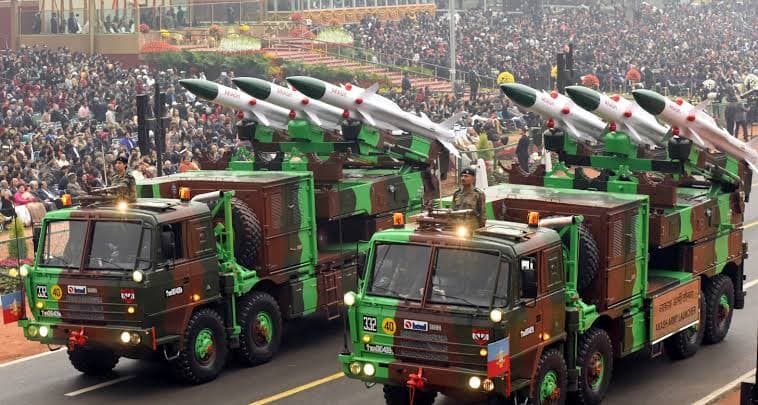
  • Successful trials of several advanced military systems including:
    • Tactical Advanced Range Augmentation System.
    • MIRV-equipped Advanced Agni missile.
    • Long-Range Land Attack Cruise Missile.
    • RudraM-II Missile.
    • Naval Anti-Ship Missile-SR.
    • Pinaka Long-Range Guided Rocket.
  • Successful test of a hypersonic missile technology featuring an active-cooled full-scale scramjet combustor operational for over 1,200 seconds.
  • The first successful test of the Kusha long-range surface-to-air missile.

Social and Infrastructure Initiatives:

  • Focus on border infrastructure development.
  • Welfare programs for serving and retired personnel.
  • Enhanced participation of women in the armed forces, evidenced by the commissioning of the** first batch of women cadets** from the National Defence Academy.
  • Recognition of the all-women tri-service circumnavigation expedition, ‘Samudra Pradakshina’.

Cultural Milestone:

  • 2026 marks 150 years since the composition of ‘Vande Mataram’; a call to celebrate national pride and contribute toward nation-building and the vision of Viksit Bharat.

This summary encapsulates the significant developments in India’s defence sector, reflecting the government's strategic focus on self-reliance, modernization, and international competitiveness.

Key Terms & Concepts

Aatmanirbhar BharatInitiatives for self-reliance
Make in IndiaInitiative for manufacturing growth
₹1.78 lakh croreRecord defence production FY 2025-26
₹686 croreDefence exports in 2013-14
₹38,424 croreDefence exports FY 2025-26
145Number of defence exporters
80Countries receiving products
₹50,000 croreDefence export target by 2029
₹7.85 lakh croreDefence budget FY 2026-27
₹29,100 croreR&D allocation increase
₹8.75 lakh croreProjects approved by Defence Acquisition Council
long-range surface-to-air missileIndigenous defence technology
Samudra Pradakshina

Mind Map for UPSC Civil Services Revision

Turn UPSC Civil Services Current Affairs Into Exam-Ready Notes

Reading National and International Importance current affairs is half the work. Revise them with ready-made notes and test what actually stuck.

  • Daily UPSC Civil Services current affairs analysis
  • Revision notes, mind maps & MCQs
  • Prelims mock tests with instant results

Related UPSC Civil Services Current Affairs Articles

Indian Army's New Defence Contracts
National and International Importance15-Aug-2026

Indian Army's New Defence Contracts

Summary of Defence Procurement Contracts

Overview:

  • The Ministry of Defence (MoD) signed contracts worth ₹1,577 crore on August 14, 2026, with Tata Advanced Systems Ltd (TASL) and NIBE Ltd for the Indian Army.

Key Details:

All-women circumnavigation expedition
2026150th anniversary of Vande Mataram

Contracts Signed:

  • TASL: ₹1,013.77 crore for 54 loiter munition systems and 540 munitions.
  • NIBE Ltd: ₹563.36 crore for 30 systems and 300 munitions.
  • Procurement Specifications:

    • Total of 84 loiter munition systems with a range of up to 100 km.
    • Enhancement of Army’s precision-strike capability, previously relying on BrahMos missiles for ranges beyond 40-50 km.
    • 60% overall indigenous content mandated:
      • Minimum of 50% in materials, components, and software.
  • Strategic Importance:

    • The loiter munition systems will bridge existing capability gaps in precision-strike operations for the Indian Army.
    • The move aligns with the government's Aatmanirbhar Bharat initiative, emphasizing indigenous defence manufacturing.

    Operational Context:

    • A limited number of artillery regiments have operationalised loiter munition systems under Phase-I.
    • Expansion plans will equip more units, enhancing overall operational effectiveness.

    Delivery Timeline:

    • Scheduled delivery within 12 months from the date of advance payment.

    Additional Information:

    • Policy Framework:
      • Contracts processed under the ‘Buy Indian’ category through Fast Track Procedure facilitate quicker acquisitions for enhanced military capabilities.

    Relevant Constitutional and Policy References:

    • Aatmanirbhar Bharat Mission: A governmental initiative aiming to boost self-reliance in manufacturing and reduce dependency on foreign imports in the defence sector.

    This procurement underscores the government's commitment to bolstering indigenous capabilities while enhancing military readiness, reflecting a strategic shift towards self-sufficiency in defence production.

    Indigenous Rights and Mining Controversy
    National and International Importance14-Aug-2026

    Indigenous Rights and Mining Controversy

    Exam-Focused Notes on the Proposed Cement Plant and Limestone Mining Project in Meghalaya

    1. Project Overview:

      • Integrated cement plant and limestone mining project proposed by Shree Cement Limited.
      • Project cost: ₹1,800 crore.
      • Location: Lum Syrman area, East Jaintia Hills district, Meghalaya.
      • Area involved: 217.394 hectares.
    2. Stakeholder Concerns:

      • Opposition from local stakeholders has led to the cancellation of public hearings since May.
      • The Jaiñtia National Council (JNC) has demanded government intervention to ensure the protection of landowners' and farmers' rights.
    3. Rights and Legal Context:

      • The JNC emphasizes the need to protect customary, possession, cultivation, and user rights of landowners from Sutnga and Nongkhlieh Elakas (traditional administrative units).
      • The organization argues that land issues should not be treated merely as environmental or industrial clearance matters but must consider local community rights.
    4. Government Accountability:

      • A 10-day deadline set by the JNC for the Meghalaya government to address their demands.
      • Calls for a transparent verification process of revenue, registration, and customary rights before proceeding with the project.
      • The JNC asserts that livelihoods of farmers must not be overlooked in favor of mineral development.
    5. Compensation and Rights:

      • The JNC demands fair and lawful compensation for any loss resulting from the project, contingent on the identification of legal and customary rights.
      • Concerns raised about the state government allegedly favoring cement companies, including blocking local residents from participating in public hearings.
    6. Constitutional and Legal Framework:

      • Relevant constitutional articles that could be referenced include:
        • Article 21: Right to life and personal liberty, which can be interpreted to include the right to livelihood.
        • Article 39 (a): Directive Principle of State Policy advocating for the right to an adequate means of livelihood for all citizens.
      • Traditional rights and local governance structures recognized under various state laws and customs.
    7. Judicial Precedents:

      • The Supreme Court and High Courts in India have previously ruled on matters concerning land acquisition, local community rights, and the need for environmental clearances, emphasizing the importance of stakeholder participation in projects affecting local communities.
    8. Environmental and Economic Implications:

      • The project has raised environmental concerns which necessitate a thorough environmental impact assessment (EIA) before any approvals.
      • Economic benefits from the project must be weighed against potential social and environmental costs.
    9. Conclusion:

      • The JNC’s stance reflects a broader issue of balancing development with community rights and environmental sustainability.
      • The outcome of this situation may set a precedent for future projects in similar contexts across India, highlighting the need for transparent governance and accountability in resource management.

    This summary encapsulates the critical aspects of the proposed project, stakeholder concerns, constitutional references, and the need for fair compensation and rights protection for local communities.

    Preservation of Ancient Monuments in India
    National and International Importance13-Aug-2026

    Preservation of Ancient Monuments in India

    Summary of Article on Protection of Ancient Monuments in India

    Overview of Ancient Monuments:

    • India has 3,688 declared ancient monuments and archaeological sites of national importance.
    • Reports indicate 414 of these sites are facing encroachments.

    Legal Framework:

    • The protection of these monuments is governed by the Ancient Monuments and Archaeological Sites and Remains Act, 1958 (AMASR Act, 1958).
    • Under this Act, acquisition or ownership of the land on which a monument is located is not mandatory for its protection.

    Responsibilities of ASI:

    • The Archaeological Survey of India (ASI) is tasked with the protection and maintenance of monuments as per the provisions of the AMASR Act, 1958, and its rules established in 1959.
    • The ASI takes appropriate action against encroachments or unauthorized activities per the relevant provisions of the AMASR Act.

    Survey and Digitization:

    • A joint survey is conducted with local revenue officials to determine the boundaries of protected monuments and sites, ensuring their protection.
    • The ASI has completed the survey, georeferencing, and digitization of these protected sites, and the data has been uploaded to the Bhuvan Portal.
    • Where necessary, this data is integrated with state land records in coordination with state governments and revenue officials.

    State-wise Encroachment Data:

    • A detailed annexure lists the number of encroached monuments by state/UT:
      • Andhra Pradesh: 1
      • Arunachal Pradesh: 1
      • Assam: 12
      • Bihar: 13
      • Chhattisgarh: 12
      • Daman and Diu (UT): 1
      • Goa: 1
      • Gujarat: 11
      • Haryana: 6
      • Himachal Pradesh: 3
      • Jammu and Kashmir (UT): 12
      • Karnataka: 60
      • Madhya Pradesh: 3
      • Maharashtra: 49
      • National Capital Delhi (UT): 14
      • Odisha: 13
      • Punjab: 3
      • Rajasthan: 30
      • Sikkim: 1
      • Telangana: 3
      • Tamil Nadu: 72
      • Tripura: 1
      • Uttar Pradesh: 78
      • West Bengal: 15
    • Total: 414 encroached sites.

    Key Takeaways:

    • The protection of ancient monuments in India is a significant legal and cultural responsibility, guided by the AMASR Act of 1958.
    • ASI plays a pivotal role in safeguarding these sites, and ongoing efforts include digitization and collaboration with state authorities to mitigate encroachments.
    • The data on encroachments is critical for assessing the effectiveness of current protective measures and informing future actions.