iAspirants
India's Indigenous Pollution Control Vessel
Published on:
Share this post
Article Summary
Summary of Key Facts and Updates on 'Samudra Pratap'
Inauguration and Design
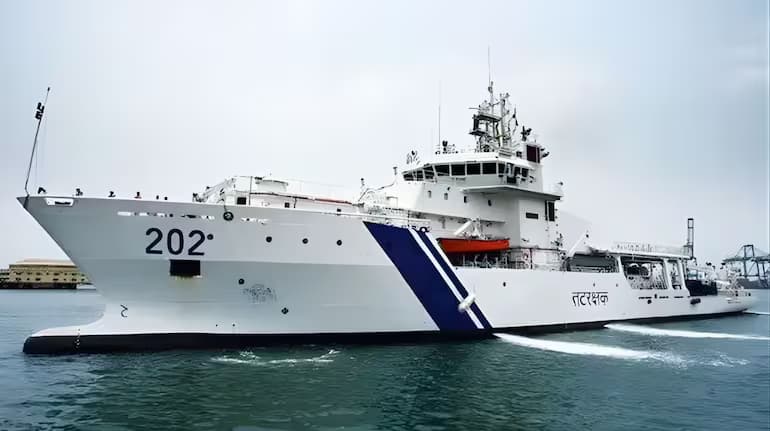
- Defense Minister Rajnath Singh inaugurated 'Samudra Pratap', India's first indigenously designed pollution control vessel on January 5, 2026.
- The vessel is built by Goa Shipyard Limited and represents a significant advancement in India's self-reliance in shipbuilding and maritime capabilities.
- Self-reliance: Over 60% of components of 'Samudra Pratap' are indigenous, with efforts to increase this to 90%.
Operational Role and Capabilities
- The vessel will augment the Indian Coast Guard's (ICG) operational capacity in pollution control, firefighting, maritime security, and environmental protection.
- Features include advanced pollution detection systems, firefighting capabilities, and a helicopter hangar, enhancing its operational effectiveness.
- Dimensions: Displacement of 4,170 tons, length of 114.5 meters, and a speed of over 22 knots; powered by two indigenous 7,500 kW diesel engines.
- Range: The vessel can operate for 6,000 nautical miles.
- Equipped with cutting-edge technology such as dynamic positioning and automated management systems for efficiency.
Significance and Strategic Impact
- As the largest vessel in the ICG fleet, 'Samudra Pratap' underscores India's commitment to enhancing its environmental response capabilities and maritime security within the Indo-Pacific region.
- The introduction of female officers on frontline coast guard vessels marks a progressive step towards gender inclusion in defense forces.
Constitutional and National Policy Context
- The incorporation of this vessel aligns with the government's "Make in India" and "Self-Reliant India" initiatives, emphasizing indigenous production in defense sectors.
- The ICG is transitioning from a platform-centric force to an intelligence-driven and integrated unit, enhancing its response to modern maritime challenges.
Judicial and Regulatory Consideration
- The deployment of 'Samudra Pratap' highlights India's adherence to international standards for maritime safety and environmental protection, as outlined in various treaties and conventions aimed at protecting marine biodiversity.
Environmental Focus
- The vessel's role extends to ensuring coastal cleanliness, protecting corals and mangroves, and mitigating climate change impacts on marine environments.
- ICG's enhanced capabilities will ensure timely responses to pollution incidents, which is crucial for preserving the ecological balance.
Government and Military Affirmations
- Rajnath Singh reaffirmed that 'Samudra Pratap' will serve as a symbol of India's responsible maritime power and will act against any adversarial actions threatening national marine domains.
- The strategic importance of this development is underscored by a commitment to a community-oriented approach in managing maritime resources, stressing that these resources should be viewed as shared heritage not confined to national ownership.
Future Directions
- The government plans to further enhance the ICG's capabilities through advanced technology, infrastructure support, and developing specialized career streams in maritime law enforcement and environmental protection.
These highlights reflect the strategic importance of 'Samudra Pratap' in fortifying India's maritime operations while promoting self-sufficiency and environmental stewardship in its waters.
Key Terms & Concepts
| Sea Pratap | Indigenous pollution control vessel |
| Indian Coast Guard | Strengthening maritime security |
| Goa Shipyard Limited | Manufacturer of Sea Pratap |
| January 5, 2026 | Inauguration date of vessel |
| 60% indigenous components | Level of local manufacturing |
| 4,170 tons | Displacement of Sea Pratap |
| 22 knots | Speed of Sea Pratap |
| 6,000 nautical miles | Range of Sea Pratap |
| 30 mm CRN-91 gun | Armament of Sea Pratap |
| Integrated Bridge System | Advanced navigation technology |
| Navy's Make in India Initiative | Promoting indigenous resources |
| Climate change | Strategic environmental challenge |
| Blue Economy |