iAspirants
Modi's Strategic Visit to Australia
Published on:
Share this post
Article Summary
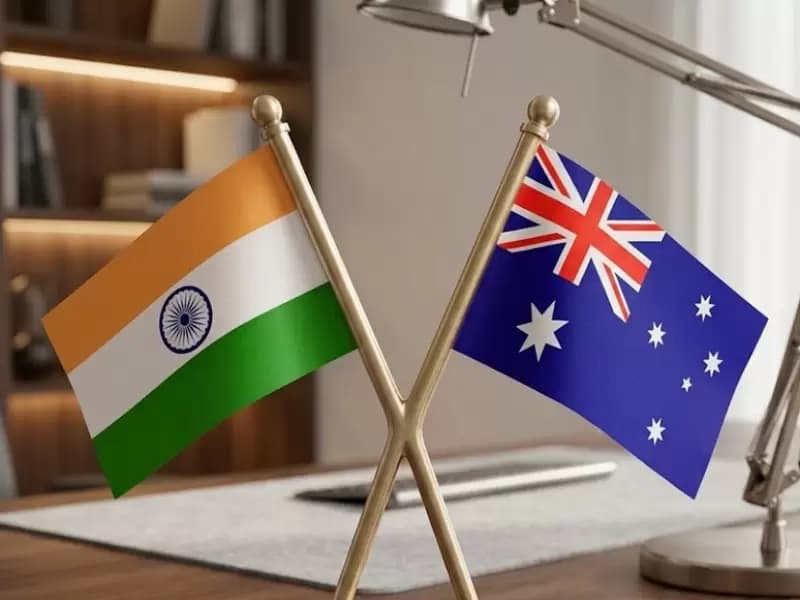
India-Australia Relations: Key Highlights from PM Modi's Visit
Strategic Context:
- Australia views India as central to its economic diversification strategy amid global dependence on China and the unpredictability of U.S. alliances.
- The Lowy Institute Poll indicates a record low trust in the U.S. (31%), prompting Australia to explore stronger ties with India.
Constitutional and Legal Framework:
- The visit reaffirmed commitments under the 2014 civil nuclear agreement, which allowed for the legal transfer of Australian uranium to India.
- The SHANTI Act reformed India’s nuclear liability regime, facilitating operationalization of uranium agreements that had been dormant for a decade.
Defense and Security Cooperation:
- A Joint Declaration on Defence and Security Cooperation was established, including a Memorandum of Understanding (MoU) between Australia’s Maritime Border Command and the Indian Coast Guard.
- Adoption of the India-Australia Maritime Security Collaboration Roadmap to address shared maritime security threats.
- The visit also launched the Australia-India Partnership on Cyber, Critical Technologies, and Supply Chains (PACTS), reinforcing technology partnerships.
Economic Data and Trade Relations:
- Trade between India and Australia has surged since the Economic Cooperation and Trade Agreement came into effect, although benefits are perceived to favor larger firms.
- A significant operational gap exists, particularly among smaller exporters who are unaware of how to leverage the agreement effectively.
Public Perception and Diaspora:
- The Lowy Poll revealed that only 5% of Australians anticipate India becoming the world's most important power in the next decade, contrasted with 54% for China.
- Indian-origin Australians are now the largest immigrant-born community in Australia, highlighting the potential for greater cultural and economic integration.
Investment Opportunities:
- PM Modi emphasized the importance of Australian pension funds investing in India, framing it as a marker of strategic trust.
- The visit aimed to enhance public consciousness regarding India as a trusted economic partner.
Geopolitical Implications:
- Both countries are Indian Ocean states with overlapping interests in maritime security, addressing threats to sea lanes and undersea cables.
- The collaborations aim to enhance operational cooperation, particularly in the Indian Ocean region.
Future Directions:
- For the India-Australia partnership to evolve from convergence to alignment, there must be operational overlap in strategic initiatives and public awareness.
- Institutionalizing the contributions of the Indian diaspora in Australia is critical for fostering economic and cultural ties.
Policy Frameworks and Agreements:
- The partnership's success hinges on translating high-level agreements into practical, operational collaboration that benefits both nations economically and strategically.
Conclusion:
- Modi's visit marked a significant step in solidifying India-Australia ties, emphasizing the need for ongoing dialogue and integration to ensure sustainable partnerships that endure beyond political changes.
This summary encapsulates the significant developments and frameworks that emerged during PM Modi's visit to Australia, highlighting the strategic, economic, and cultural dimensions of the evolving bilateral relationship.
Key Terms & Concepts
| Australia-India Partnership on Cyber, Critical Technologies and Supply Chains (PACTS) | Strengthening tech partnerships |
| Joint Declaration on Defence and Security Cooperation | Enhancing defense collaboration |
| Economic Cooperation and Trade Agreement | Facilitating trade growth |
| SHANTI Act | Reforming nuclear liability law |
| Lowy Institute Poll | Measuring public trust levels |
| India-Australia Maritime Security Collaboration Roadmap | Addressing maritime threats |
| AUKUS | Trilateral security partnership |
| 2014 civil nuclear agreement | Bilateral nuclear cooperation |
| Indian Ocean | Region of strategic interests |
| U.S. President Donald Trump | Context for Australia-U.S. relations |