iAspirants
New Findings on Solar Magnetism
Published on:
Share this post
Article Summary
Summary Notes on Research Findings Regarding Sun's Magnetism
Study Overview
- Conducted by researchers from the Tata Institute of Fundamental Research (TIFR), Mumbai, and New York University, Abu Dhabi.
- Published in Nature Astronomy.
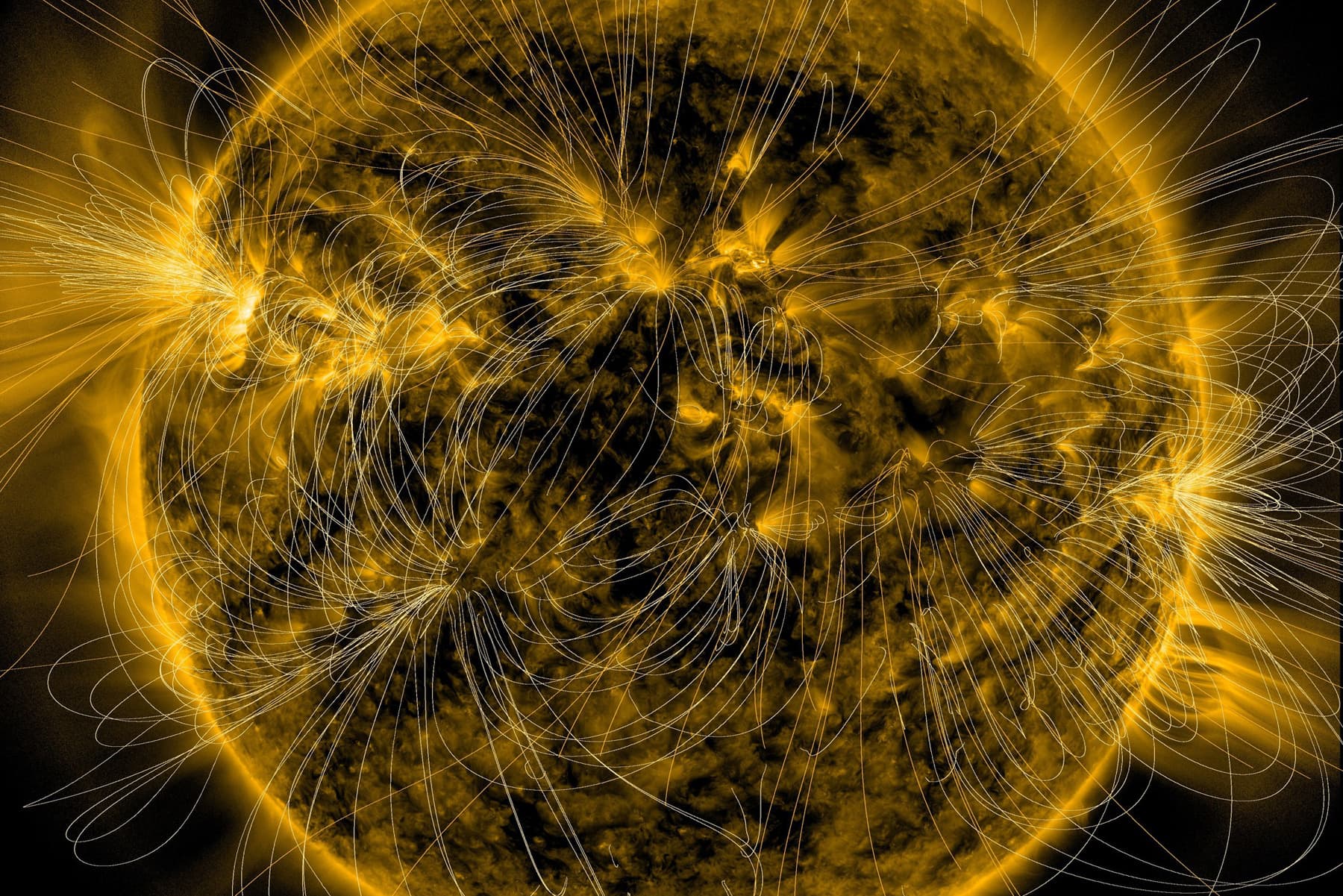
- Focuses on the detection of magnetism movements inside the Sun that may aid in predicting solar storms.
Methodology
- Utilized helioseismology: a technique analogous to how earthquakes inform about Earth's interior but applied to solar observations.
- Analyzed over 5,000 days of data from NASA's Solar Dynamics Observatory.
- Used the Helioseismic and Magnetic Imager (HMI) to track oscillations and magnetic activity across the Sun.
Key Findings
- Detected magneto-Rossby waves—large waves affected by magnetic fields and fluid movement beneath the Sun's surface in the convection zone, where plasma circulates to transfer heat into space.
- A new doughnut-shaped magnetic field was identified beneath the solar surface, potentially powerful and contributing to the solar cycle (an 11-year cycle of solar activity).
Importance of Research
- Strong solar activity, including solar flares, can disrupt technologies on Earth such as satellites and power grids.
- The study's findings provide a clearer understanding of the solar cycle, which has implications for predicting solar activity that affects Earth.
Potential Applications
- Improved forecasting of solar storms may enhance preparedness for disruptions in satellite communications and energy production.
- If these magnetohydrodynamic waves can be tracked, researchers could monitor changes in the solar magnetic field throughout the solar cycle, potentially improving predictions of solar cycle intensity and its consequent effects on Earth.
Future Directions
- Researchers caution that while the findings are promising for forecasting solar activity, more studies are necessary to establish concrete predictive capabilities regarding solar storms and cycles.
Scientific Context
- This discovery fills a gap in observational and theoretical understanding of solar activities, paving the way for advancements in space weather forecasting methodologies.
Conclusion
- The research significantly contributes to our understanding of solar magnetism and its potential impacts on space weather, emphasizing the need for continuous observation and analysis.
Key Terms & Concepts
| Tata Institute of Fundamental Research | Research organization involved |
| New York University, Abu Dhabi | Collaborating research institution |
| Nature Astronomy | Journal where study published |
| Helioseismology | Method used for study |
| Solar Dynamics Observatory | NASA satellite for observation |
| Helioseismic and Magnetic Imager | Instrument for solar measurement |
| Magneto-Rossby waves | Waves detected within Sun |
| Convection zone | Layer where waves detected |
| Solar cycle | 11-year activity pattern of Sun |
| Prof Shravan Hanasoge | Lead researcher of the study |