iAspirants
New Insights from Homo Erectus Fossil
Published on:
Share this post
Article Summary
Summary of Scientific Findings on Early Homo Erectus
Fossil Discovery and Reconstruction
- Fossil Name: DAN5
- Location: Found near Gona, Afar region, Ethiopia.
- Age: Approximately 1.5 to 1.6 million years old.
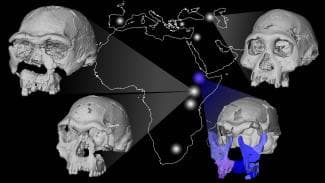
- Significance: Considered the most complete fossil human skull from this era in the Horn of Africa.
- Research Team Lead: Dr. Karen Baab, Midwestern University.
Key Features
- The reconstruction reveals primitive facial features typical of early hominins, challenging previous notions about Homo erectus.
- Braincase: Small braincase consistent with early Homo erectus.
- Facial Structure: Primitive traits, including a flat nasal bridge and large molars, indicating a mix of anatomical features between archaic and more recent hominins.
Research Techniques
- Utilized high-resolution micro-CT scans to create detailed 3D models, aligning fragments of the skull.
- The process was likened to solving a complex 3D puzzle.
Evolutionary Insights
- Suggests that certain populations may have retained ancestral traits longer, reflecting diverse paths of evolution.
- Reassesses the understanding of Homo erectus as predominantly having an African origin, with transitional forms present on the continent rather than outside.
Archaeological Context
- DAN5 is associated with the making of both Oldowan tools and Acheulian handaxes, indicating technological development during its lifetime.
- Highlights anatomical diversity among early human populations; no single Homo erectus body plan existed.
Future Research Directions
- Planned comparisons with early European fossils, such as Homo erectus and Homo antecessor, approximately one million years old.
- Aims to elucidate facial variation and evolutionary adaptations as Homo erectus spread across different regions.
Notes on Population Dynamics
- The study posits potential admixture between Homo erectus and earlier species like Homo habilis.
- Emphasizes the need for more fossil specimens (1-2 million years old) to better understand evolutionary relationships.
This summary encapsulates significant findings regarding the early stages of human evolution as revealed through the discovery and analysis of the DAN5 fossil, providing insights into the diversity, anatomical characteristics, and technological context of early Homo erectus.
Key Terms & Concepts
| DAN5 | Fossil specimen studied |
| 1.5 to 1.6 million years | Dating of fossil discovery |
| Nature Communications | Journal publishing study |
| Gona Paleoanthropological Research Project | Research initiative for fossil studies |
| 6.3 million years | Age of discovered fossils |
| Oldowan tools and Acheulian handaxes | Technologies associated with fossils |
| Braincase and facial structure | Anatomical characteristics studied |
| 3D models | Method for reconstruction |
| Homo habilis | Species compared in study |
| Population diversity | Evolutionary concept discussed |