iAspirants
New Method for Ionospheric Reconstruction
Published on:
Share this post
Article Summary
Summary of Key Facts and Developments
Scientific Achievement:
- Research Breakthrough: A novel method has been developed to reconstruct the upper ionosphere over India by integrating ground-based and space-based observations. This is crucial for satellite operations, communication systems, and navigation services.
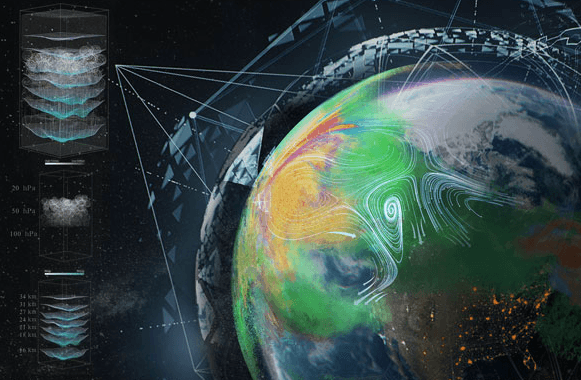
- Ionosphere Importance: The ionosphere is a complex, ionized part of the Earth's upper atmosphere that plays a vital role in atmospheric and ionospheric electrodynamics. Daily variations in electron density significantly affect radio wave propagation across different frequency bands.
Technical Insights:
- Radio Communication: High-frequency (HF) band multi-hop signals enable long-distance radio communication via skywave propagation.
- GPS Impact: The ionosphere affects GPS and satellite-based navigation systems due to variations in signal transmission.
Methodology:
- Electron Density Monitoring: Accurate electron density information up to approximately 1000 km is necessary for continuous ionospheric monitoring, as most low Earth orbit satellites operate within this altitude.
- New Approach: The Indian Institute of Geomagnetism (IIG), under the Department of Science and Technology (DST), has proposed a new method that combines cosmic radio occultation measurements with bottomside ionosonde observations to enhance the accuracy of topside electron density profiles.
Data and Analysis:
- Seasonal Density Profiles: The study includes seasonal reconstructions of electron density profiles, indicating improved understanding of the ionosphere and more accurate regional estimates of topside height trends.
- Validation: The proposed method has been validated using correlation analysis between measured and reconstructed densities for the year 2014.
Significance:
- Regional Modeling: This method enhances the accuracy of regional ionospheric modeling under various space weather conditions, which is particularly important in the geomagnetic equatorial region due to complex ionospheric dynamics.
- Broader Applications: The study, published in the AGU Radio Science Journal, has implications for improving space weather forecasting capabilities and ensuring the reliability of communication and navigation systems.
Conclusion:
The integration of ground and space-based observations for ionospheric research represents a significant advancement in understanding atmospheric dynamics, critical for enhancing satellite communication and navigation systems in the Indian region.
Key Terms & Concepts
| Indian Institute of Geomagnetism | Developed new reconstruction method |
| Department of Science and Technology | Oversaw the research project |
| Cosmic Radio Occultation | Measurement technique used |
| Topside Electron Density Profile | Key parameter for modeling |
| AGU Radio Science Journal | Published the study |
| 2014 | Year of significant measurements |
| Ionosphere | Upper atmospheric layer studied |
| GPS | Navigation system affected |
| Radio Waves | Communication medium analyzed |
| Multi-hop Signals | Long-distance radio communication |