iAspirants
Current AffairsPrelims PYQsUPSC CSE SyllabusUPSC CSE StrategyBlogsPricing
Login
iAspirants

Your AI-powered companion for UPSC preparation.

Quick Links

  • Home
  • About Us
  • Current Affairs
  • Prelims PYQs
  • UPSC CSE Syllabus
  • UPSC CSE Strategy
  • Blogs

Company

  • Pricing
  • FAQs
  • Contact Us
  • Login

Legal

  • Privacy Policy
  • Terms & Conditions
  • Return Policy

© 2025 iAspirants, Inc. All rights reserved.

  1. Blogs
  2. Environment and Ecology

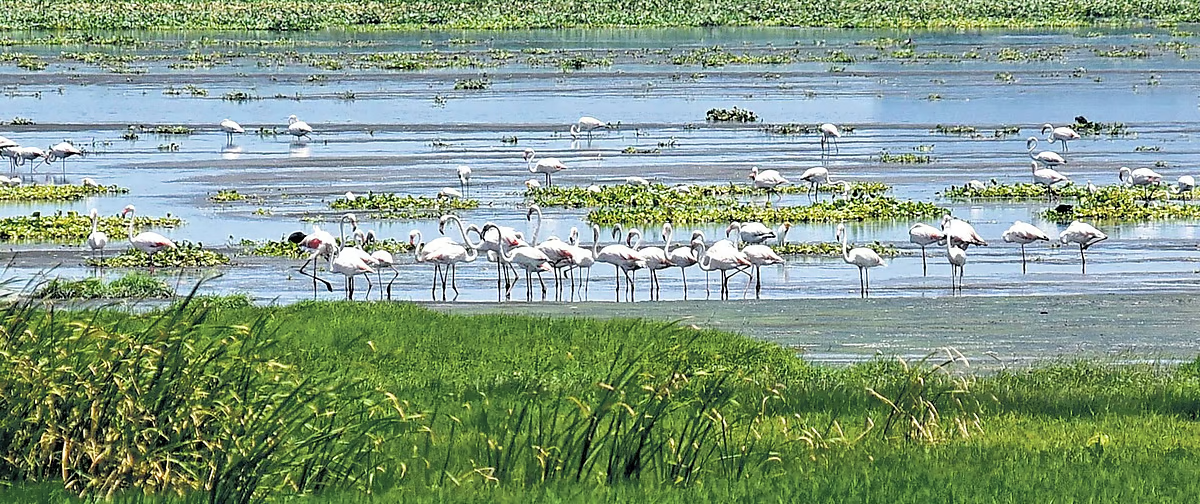
Policy Gaps in Pallikaranai Marshland

Published on: 10-Sep-2026

Share this post

Policy Gaps in Pallikaranai Marshland

Article Summary

Summary of the Pallikaranai Collective Report

Key Recommendations

  1. Formation of Committee:

    • An independent interdepartmental committee is proposed to study policy and legislative gaps regarding the Pallikaranai marshland.
    • This committee should include subject-matter experts and representatives of the community to create a coordinated implementation plan.
  2. Policy Review and Legislative Gaps:

    • The report titled ‘Citizen’s Charter for Pallikaranai Watershed’ highlights significant gaps in existing policies:
      • Tamil Nadu Water Policy (1994) has not been updated.
      • A State Water Policy drafted in 2024 remains unnotified.
      • No Flood Plain Zoning Act has been enacted in Tamil Nadu despite a central government template issued in 1975.
  3. Data Transparency:

    • The Thiruppugazh Committee's final report from May 2023, which studied 1,189 square kilometers and 30 years of flood data, is not publicly accessible.
    • The Tamil Nadu Water Resources Information and Management System contains data on 92,068 tanks and 127 reservoirs, which is not available to the public.

Environmental Management Proposals

  • Wetland Management:

    • The charter emphasizes that Wetland Rules are poorly implemented and that Pallikaranai marshland has not been formally notified as protected under these rules.
    • Demands include:
      • Demarcation and mapping of wetlands and floodplains under the Wetland (Conservation and Management) Rules, 2017.
      • Implementation of the Flood Plain Zoning Act.
      • Regular desilting and maintenance of canals.
      • Prevention of sewage discharge into water bodies.
  • Waste Management:

    • Advocates for the source segregation of household waste.
  • Protective Measures:

    • Calls to remove encroachments and illegal infrastructure within the Pallikaranai Ramsar site and its buffer zones.

Legal and Constitutional Context

  • The recommendations align with environmental conservation principles outlined in the Indian Constitution, particularly Article 48A, which directs the State to protect and improve the environment and safeguarding of forests and wildlife.

Significance

  • The proposed measures aim to enhance the ecological health of Pallikaranai marshland, a vital wetland ecosystem, and facilitate better water management and flood control for the area.

Conclusion

The Pallikaranai Collective's report calls for immediate and coherent action to address significant environmental concerns regarding the Pallikaranai marshland, underlining the need for effective policy implementation and data transparency for sustainable water management.

Key Terms & Concepts

Pallikaranai marshlandGeographical Area Under Study
Tamil Nadu Water PolicyPolicy for Water Management
Flood Plain Zoning ActLegislative Requirement for Flood Control
Wetland (Conservation and Management) Rules, 2017Regulation for Wetland Protection
Thiruppugazh CommitteeStudy on Flood Data
Chennai Wetlands Action CollectiveConservation Group Involved
Oorvani FoundationNGO Collaborating on Charter
Pallikaranai Ramsar siteProtected Wetland Area
92,068 tanks and 127 reservoirsWater Bodies Data In Tamil Nadu
1,189 square kilometresArea Studied for Flood Impact
May 2023Report Submission Date
1994Year of Water Policy Drafting

Mind Map for UPSC Civil Services Revision

Turn UPSC Civil Services Current Affairs Into Exam-Ready Notes

Reading Environment and Ecology current affairs is half the work. Revise them with ready-made notes and test what actually stuck.

  • Daily UPSC Civil Services current affairs analysis
  • Revision notes, mind maps & MCQs
  • Prelims mock tests with instant results

Related UPSC Civil Services Current Affairs Articles

Increase in Winter Waste Burning
Environment and Ecology10-Sep-2026

Increase in Winter Waste Burning

Summary of Key Findings on Open Waste Burning in Indian Cities

Key Findings from WRI Study (2019-2026)

  • Waste Burning Increase: Open waste burning incidence rises sharply in winter cities, with an average increase in quantity of waste burned and associated emissions being three times higher than in summer.
  • : The study involved field surveys across 11 polluted Indian cities.
1975Year for Union Government Template
Citizen’s Charter for Pallikaranai WatershedReport on Policy Gaps
ChennaiCity In Tamil Nadu
Cities Surveyed
  • Tier 2 and 3 Cities:
    • Tier 2 Cities (population: 500,000 - 5 million):
      • Highest quantity of waste burned.
      • Waste burned volume doubled from ~21 tonnes/day in summer to ~41 tonnes/day in winter.
    • Tier 3 Cities: Highest winter incidence of burning, with an average of 49.6 incidents/km²/day, compared to 46 in Tier 2 and 39.4 in Tier 1 cities.
  • Public Health and Pollution

    • Pollution Contribution: Open waste burning contributes less than 1% to citywide PM2.5 and PM10 emissions but is significant in localized areas due to proximity to homes and streets.
    • Socio-Economic Impact:
      • Poorer areas demonstrate a higher frequency of burning incidents (~84 incidents/km²/day in Tier 2 cities).
      • Indicates disparities in waste management services across socio-economic strata.

    Environmental Conditions

    • Seasonal Factors:
      • Winter conditions lead to weaker winds and stable atmospheric conditions, causing difficulty in the dispersion of pollutants.
      • Increased waste burning is partly attributed to its use as a source of warmth during colder months.

    Government and Policy Responses

    • Commission for Air Quality Management (CAQM): Introduced initiatives aimed at curbing open waste burning in the National Capital Region (NCR).
      • Identifying waste dumping/burning sites.
      • Training waste management personnel and conducting awareness campaigns.
      • Development of pilot solutions for future scalability.
    • Zero-Tolerance Approach: Emphasis on stringent inspections under ‘Operation Clean Air’.
    • Union Environment Ministry Initiatives: In May, the ministry urged Delhi authorities to:
      • Increase waste processing capacity before September.
      • Implement enforcement teams to prevent winter waste burning.
      • Provide heating facilities for workers to minimize the motivation for burning waste for warmth.

    Conclusion

    The rise in open waste burning during winter months in Indian cities poses significant public health risks and highlights socio-economic disparities in waste management. Government initiatives, particularly from the CAQM and the Union Environment Ministry, are being implemented to manage and reduce these emissions, focusing on enhancing waste management infrastructure and community awareness.

    NHAI Tightens Tree Plantation Guidelines
    Environment and Ecology09-Sep-2026

    NHAI Tightens Tree Plantation Guidelines

    Summary of NHAI's New Guidelines on Tree Plantation for Highway Projects

    Key Highlights:

    • Authority: National Highways Authority of India (NHAI)
    • Focus: Strict compliance for tree plantation in highway projects before issuing Provisional Completion Certificates (PCC).

    New Guidelines:

    1. Tree Plantation Requirements:

      • Minimum Plantation Coverage: 80% of the designated Right of Way (RoW) must be planted.
      • Survival Rate: At least 90% of the planted trees must survive at the time of inspection.
    2. Relevant Policies:

      • Compliance with the Green Highways Policy, 2015.
      • Adherence to IRC:SP:21-2009 and other guidelines issued by the Ministry of Road Transport & Highways and NHAI.
    3. Provisional Completion Certificate (PCC):

      • Issuance of PCC is contingent upon meeting the minimum tree plantation and survival criteria.
      • Any shortfall in the required 80% plantation must be compensated within a specified timeframe, with financial penalties applied until full compliance is achieved.
    4. Operational and Maintenance (O&M) Requirements:

      • Strengthened tree plantation requirements during the operational phase of highways.
      • O&M payments, especially for Hybrid Annuity Mode and Build-Operate-Transfer projects, are linked to maintaining a minimum survival rate of 90% for planted trees.
    5. Plant Replacement:

      • Timely replacement of dead or damaged plants is mandated to maintain uniformity and continuity in tree cover along highways.
    6. Technical Assistance:

      • NHAI will engage environmental and plantation specialists to verify compliance with survival standards before processing maintenance payments.

    Environmental Commitment:

    • The revised guidelines reflect NHAI's commitment to integrate environmental sustainability and plantation management within the core framework of highway project implementation and maintenance.

    Judicial and Regulatory Context:

    • The guidelines aim to address past issues where tree plantation obligations were inadequately prioritized during the PCC issuance process, reinforcing the importance of environmental considerations in infrastructure development.

    Conclusion:

    NHAI's new stringent guidelines aim to enhance the ecological integrity of highway projects by ensuring robust tree plantation and maintenance protocols, thereby aligning with national environmental goals and sustainable development practices.

    Impact of Flash Floods in Himalayas
    Environment and Ecology08-Sep-2026

    Impact of Flash Floods in Himalayas

    Natural Disasters and Climate Impact in the Himalayas

    1. Recent Flooding Events:

      • Significant flash floods occurring in Kedarnath, Chamoli, Sikkim (India), and Rasuwa (Nepal).
      • Casualties reported: 1,356 confirmed dead in Nepal as of September 7; 4,994 people remain missing.
    2. Scientific Terminology:

      • Terms like "hazard cascades" and "GLOF" (glacial lake outburst flood) are central to understanding the nature of these disasters.
    3. Cultural Context:

      • Historical knowledge within local communities highlights the dangers of overcrowding in narrow valleys and unsustainable infrastructure development.
    4. Climate Compensation:

      • Nepal's Prime Minister addresses global climate compensation amid demands for recognition of losses due to climate injustice.
      • Increasing discourse around the impacts of global warming and climate agreements (e.g., Paris Agreement) seeming ineffective against rising global temperatures, exceeding the target of 1.5 degrees Celsius.
    5. Political and Economic Repercussions:

      • The floods showcase the need for a unified climate response among South Asian countries, shifting the focus toward ecological diplomacy.
      • The socio-political landscape in Nepal is influenced by previous disasters like the 2015 earthquake, which claimed 8,000 lives and provoked a surge in national unity, though subsequent political expectations were unmet.
    6. Judicial and Political Commentary:

      • Nepal's politics of disaster aid involves debates around legitimacy and the effectiveness of political parties in response efforts.
      • Criticism arises regarding delays in rescue operations and the management of relief funds, raising concerns about the ethics of social media conduct amidst disasters.
    7. Future Direction:

      • The floods signify an urgent call for a reimagining of ecological governance and political unity in addressing climate issues.
      • The emphasis on not merely reconstructing infrastructure but integrating environmental considerations and community welfare into developmental policies.
    8. Broader Cultural and Historical Narrative:

      • The legacy of past revolutions in Nepal shapes current political discourse and responses to natural calamities, reinforcing a cycle of transition that requires resolution.
    9. Global Alliances for Ecological Governance:

      • A proposition for South Asian countries to forge new international alliances focused on ecological governance, connecting diverse ecological zones (e.g., Himalayas, Arctic, and Antarctic) to combat climate change collectively.
    10. Ecological Significance of the Himalayas:

      • Recognition of the Himalayas as the "Third Pole" emphasizes its critical role in global climate systems and the need for united efforts in environmental conservation.

    In summary, the severe flash floods in the Himalayan region highlight the intersections of climate change, socio-political dynamics, and cultural histories, calling for immediate and coordinated actions on both local and global scales.

    India-Japan Joint Forestry Meeting Highlights
    Environment and Ecology08-Sep-2026

    India-Japan Joint Forestry Meeting Highlights

    Summary of the India-Japan Joint Working Group Meeting on Forestry

    Event Details:

    • Meeting Date: September 8, 2026
    • Location: Bengaluru, India
    • Participants:
      • India: Ramesh Kumar Pandey, Additional Director General (Forests), Ministry of Environment, Forest and Climate Change.
      • Japan: Kotaro Shimizu, Deputy Director General, Forestry Agency, Ministry of Agriculture, Forestry and Fisheries.

    Key Discussion Areas:

    1. Trees Outside Forests (TOF) Program:

      • Focus on assessment, management, and genetic improvement of tree resources outside forests.
      • Sharing of experiences related to genetic resource conservation, tree breeding, advanced planting materials, and the conservation of live genetic materials.
    2. Forest Resources:

      • Discussions on forest inventory, assessment of forest resources, and geospatial and monitoring technologies.
  • Roadmap Support:

    • Affirmation of commitment to the 2027-2031 roadmap under the Memorandum of Cooperation (MoC) signed in 2015.
    • Emphasis on deepening cooperation in forestry, biodiversity conservation, research, and capacity development.
  • Outcomes:

    • Signing of the minutes of the 7th Joint Working Group (JWG) meeting.
    • Planned visits to various forestry and agricultural sites in Karnataka and Mysuru, including:
      • Institute of Wood Science and Technology, Bengaluru.
      • Sandalwood Agroforestry Farm and Processing Unit in Mysuru.
      • Nagarhole Tiger Reserve to exchange experiences on sandalwood cultivation and wildlife conservation practices.

    International Agreements and Cooperation:

    • The meeting reaffirms the ongoing collaboration between India and Japan in forestry and environmental conservation, enhancing bilateral relations.

    Important Notes:

    • The discussions align with global efforts to enhance forest resource management and biodiversity conservation.
    • The exchange of expertise in forestry genetics and conservation is crucial for sustainable forestry practices.

    This meeting highlights the commitment of both nations to cooperative environmental management and sustainable development in forestry, reflecting broader international environmental goals.