iAspirants
Shift to Electric Cooking in India
Published on:
Share this post
Article Summary
Summary of Key Facts and Developments
Conflict and Economic Impact
- Recent conflict in West Asia prompted a ceasefire on April 9, 2026.
- Spillover effects include elevated crude oil prices causing supply issues within India, including black-market LPG sales.
Shift to Electric Cooking
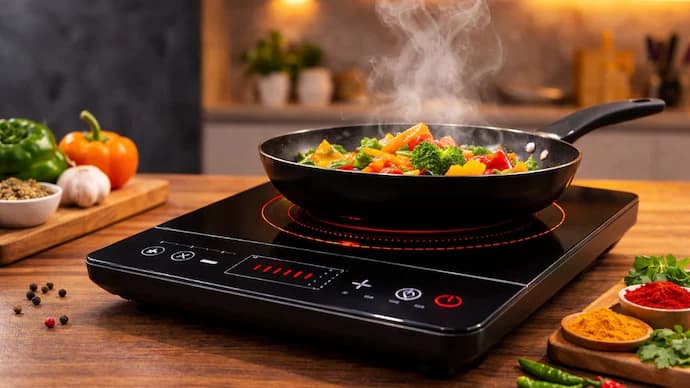
- Increase in Electric Cooktops: Post-conflict, sales of induction cooktops surged, witnessing an 18-fold increase compared to pre-war periods. Infrared cooktops saw sales quadruple.
- Government Discussion: An inter-ministerial discussion was held to augment production of induction heaters and compatible utensils, though details from the Ministry of Commerce and Industry remain unavailable.
Cooktop Efficiency and Economics
- Cost Comparison: Basic induction cooktops priced between ₹3,000-4,000, comparable to black market prices of LPG cylinders.
- Induction Cooktop Efficiency: Converts 85-95% of electricity into heat using electromagnetic fields.
- Infrared Cooktop Efficiency: Operates at 70-80% efficiency as it requires a multi-step heating process, potentially leading to energy loss.
Grid Infrastructure Challenges
- Increased demand for electricity poses a risk to local distribution networks, particularly during peak hours when cooking contributes substantially to consumption.
- Estimated potential load increase: 3-5 GW during concentrated peak cooking hours.
- The current infrastructure may not support sudden spikes in demand, risking overload and service interruptions.
Seasonal Considerations and Government Response
- Predicted “hotter-than-normal” summer in 2026 may increase power demand, leading the government to rely more on coal-based power.
- Previous emergency measures invoked to ensure full capacity operation of both gas and coal plants during high consumption periods.
Scientific and Technical Insights
- Induction Cooktops: Utilize a magnetic field to directly heat compatible cookware made from ferromagnetic materials.
- Infrared Cooktops: Use radiant heat generated by heated coils beneath a glass surface, usable with various cookware but less efficient than induction.
Conclusion
- The transition to electric cooking poses significant implications for energy demand and infrastructure, particularly as India navigates political conflicts in energy-producing regions and anticipates a hotter climate. The government's focus remains on addressing these challenges, ensuring a sustainable shift in household energy dependence while managing the associated impacts on the electricity grid.
Key Terms & Concepts
| Crude Oil Prices | Highlight economic impact |
| LPG Cylinder Sales | Show household fuel shortages |
| Induction Cooktops | Electric alternative to LPG |
| Infrared Cooktops | Alternative cooking solutions |
| Rs 3,000-4,000 | Cost comparison to LPG |
| 18-fold increase | Spike in induction sales |
| 3-5 GW | Estimated increase in demand |
| The Energy and Resource Institute (TERI) | Expert analysis on demand spikes |
| Coal-based power | Government's peak demand strategy |
| Electricity waveform | Technique for heat control |
| Peak summer load | Increased strain on grid |
| Distribution Transformers | Critical infrastructure concern |