iAspirants
Significance of the Airy Transit Circle
Published on:
Share this post
Article Summary
Key Facts and Notes on the Airy Transit Circle (ATC)
Historical Significance:
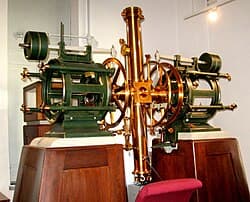
- The ATC, designed by English astronomer George Biddell Airy, was monumental in defining the prime meridian at the Royal Observatory in Greenwich.
- Recognized as one of the most important telescopes historically, its usage was critical in establishing an accurate system for timing celestial events.
Design and Operation:
- The ATC is a type of precision instrument known as a transit circle, which is used to measure the passage of stars across the local meridian.
- It operated for over 100 years, with its first observation recorded on January 4, 1851, and concluded its service in 1954.
- The telescope featured massive stone piers to support its structure, emphasizing its construction precision.
Impact on Timekeeping and Navigation:
- In 1884, during an international conference in Washington D.C., the cross-hairs of the ATC were agreed upon to define Longitude 0°, marking the start of the universal day.
- The location of the prime meridian has slightly shifted due to the Earth's crust movements, although the ATC remains a historical reference point.
Notable Figures:
- George Biddell Airy (1801-1892) was a prominent figure in the scientific community, holding the position of Astronomer Royal from 1835 until 1881.
- He significantly advanced the Royal Observatory, modernizing measurement systems and enhancing its operational capacity.
Scientific Contributions:
- Airy authored Mathematical Tracts on Physical Astronomy and participated in various scientific endeavors, including overseeing pendulum experiments to assess gravity variations at different depths.
- He was involved in numerous eclipse expeditions across Europe, furthering astronomical observations.
Controversies:
- The delayed discovery of Neptune resulted in contention between British and French astronomers, with Airy being unfairly blamed for not pursuing the calculations made by John Couch Adams.
- Despite this setback, he later advocated for Adams, ensuring recognition of his contributions to astronomy.
Awards and Recognitions:
- Airy was knighted in 1872 and contributed as a scientific advisor for various government projects, including the laying of the transatlantic telegraph cable.
Legacy:
- Airy’s meticulous nature and comprehensive documentation of his work have greatly contributed to the scientific archives, leaving a lasting impact on astronomy and scientific practices in Britain.
Environmental Context:
- The ATC's operation emphasized the importance of accurate star mapping for both navigation and timekeeping, foundational aspects contributing to global connectivity.
This summary encapsulates the significance of the Airy Transit Circle in astronomy, its historical context, and key figures involved, in a manner conducive to exam preparation.
Key Terms & Concepts
| Airy Transit Circle | Defined the prime meridian |
| Royal Observatory Greenwich | Location of the ATC |
| January 4, 1851 | Date of first observation |
| 1938 | Year of continuous operation end |
| 1954 | Last observation year |
| Prime meridian | Start of universal day |
| Washington D.C. conference | Established international time zones |
| Longitude 0° | Defined by ATC eyepiece cross-hairs |
| Harton Colliery experiment | Measured change in gravity |
| Eclipse expeditions | Participated in astronomical observations |
| Transatlantic telegraph cable | Scientific advice on construction |
| Big Ben | Advised on construction chimes |