iAspirants
Current AffairsPrelims PYQsUPSC CSE SyllabusUPSC CSE StrategyBlogsPricing
Login
iAspirants

Your AI-powered companion for UPSC preparation.

Quick Links

  • Home
  • About Us
  • Current Affairs
  • Prelims PYQs
  • UPSC CSE Syllabus
  • UPSC CSE Strategy
  • Blogs

Company

  • Pricing
  • FAQs
  • Contact Us
  • Login

Legal

  • Privacy Policy
  • Terms & Conditions
  • Return Policy

© 2025 iAspirants, Inc. All rights reserved.

  1. Blogs
  2. Art and Culture

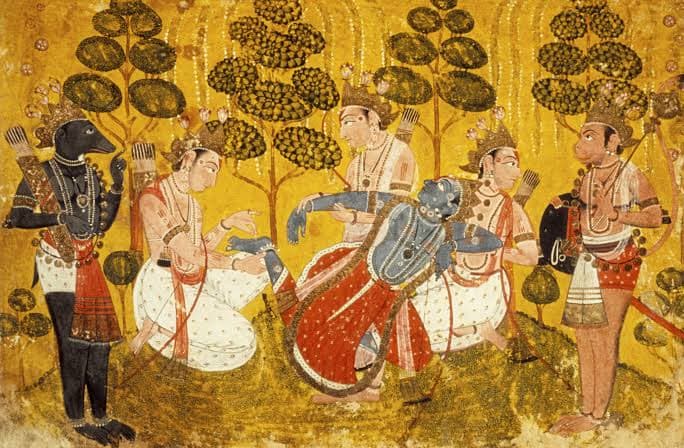
Valmiki Ramayana and Valmiki's Life

Published on: 27-Aug-2026

Share this post

Valmiki Ramayana and Valmiki's Life

Article Summary

  • Literary Work: The Valmiki Ramayana is identified as the sole literary work that specifically addresses the Rama avatara, termed "adi kavya" (first poetic work) as it follows the Vedas, which do not have an identifiable author.

  • Comparative Avatara Analysis: Other literary works like the Srimad Bhagavatam and Vishnu Purana also discuss Krishna avatara, but these are not exclusively centered on Krishna:

    • Srimad Bhagavatam: Primarily focuses on various subjects, with only the tenth skanda dedicated to Krishna.
    • Vishnu Purana: Contains five amsas, with only the fifth centered on Krishna; other amsas include Varaha and Narasimha.
  • Valmiki's Life and Penance:

    • Valmiki underwent rigorous penance through eight stages:
      1. Yama (moral discipline)
      2. Niyama (self-discipline)
      3. Pranayama (breath control)
      4. Pratyahara (withdrawal of the senses)
      5. Asana (posture)
      6. Dharaṇa (concentration)
      7. Dhyana (meditation)
      8. Samadhi (state of oneness with the object of meditation).
    • His extensive penance led to the formation of a termite hill around him, which is the origin of his name "Valmiki."
  • Valmiki's Encounter with Rama:

    • Valmiki began writing the Ramayana during the reign of Rama in Ayodhya, specifically before the banishment of Sita.
    • Through a dialogue with Narada, Valmiki sought to identify the ideal man of his time, recognizing that only Rama embodied the 16 great qualities described.
  • Cultural Significance: The Ramayana, as the first narrative post-Vedic texts, holds significant cultural and historical value in Indian literature and spirituality, demonstrating themes of morality, idealism, and devotion.

These notes capture essential facts and teachings from the discourse on Valmiki Ramayana while emphasizing its significance in literary and cultural history.

Key Terms & Concepts

Valmiki RamayanaEpic literary work
Srimad BhagavatamHindu scripture discussing Krishna
Vishnu PuranaText on Hindu mythology
adi kavyaFirst literary work style
DasarathaKing of Ayodhya
NaradaSage who visited Valmiki
eight stages in penanceStages of spiritual discipline
yama, niyama, pranayamaFirst three stages of penance
samskarasRituals to prepare for spiritual practices
termite hillShelter during penance

Mind Map for UPSC Civil Services Revision

Turn UPSC Civil Services Current Affairs Into Exam-Ready Notes

Reading Art and Culture current affairs is half the work. Revise them with ready-made notes and test what actually stuck.

  • Daily UPSC Civil Services current affairs analysis
  • Revision notes, mind maps & MCQs
  • Prelims mock tests with instant results

Related UPSC Civil Services Current Affairs Articles

The Lesson of Vamana and Mahabali
Art and Culture26-Aug-2026

The Lesson of Vamana and Mahabali

  • Contextual Background: The narrative revolves around the Hindu mythological figure Vamana (the dwarf incarnation of Lord Vishnu) and the asura king Mahabali, highlighting themes of dharma (righteousness) and devotion (bhakti).

  • Core Event: Vamana requests three feet of land from Mahabali, representing humility and divine selflessness. This event is significant in showcasing the contrast between divine authority and earthly duty.

  • Decision-making:

    • Mahabali, renowned for his charity and piety, faces a moral dilemma: obey his guru Sukrachariar, who advises against granting Vamana's request, or adhere to the path of dharma by recognizing Vamana as a divine presence.
    • Mahabali ultimately chooses to give the land, underscoring his commitment to righteousness over blind obedience.
  • Symbolic Actions:

    • Vamana transforms into Trivikrama, symbolizing the idea that divinity can shape reality.
    • Sukrachariar’s attempts to block the alms-giving are thwarted by Vamana, representing the victory of divine will over ignorance.
  • Philosophical Teachings:

    • The narrative reinforces the notion articulated by Tiruvalluvar that preventing someone from performing a charitable act is a significant wrongdoing.
    • Highlights the importance of the guru-disciple relationship, positing that even divine entities respect this bond.
  • Outcome and Significance:

    • Mahabali's choice earns him a place in celestial realms, functioning as a guardian with the privilege of visiting his subjects annually.
    • This yearly event is commemorated as Onam, a festival signifying unity and prosperity across cultures, primarily in Kerala.
  • Cultural Importance: Onam serves as a reminder of the principles of charity, loyalty, and the celebration of goodness over evil.

  • This mythological context integrates religious, ethical, and philosophical dimensions, affirming the individual's duty to righteousness amidst conflicts of authority and loyalty.

    Award for Prisoner Author's Memoir
    Art and Culture24-Aug-2026

    Award for Prisoner Author's Memoir

    Exam-Focused Summary Notes

    • Award Recognition:

      • C. Selvam, a life convict, has been awarded the Iyal Award for non-fiction by the Canada-based Tamil Literary Garden for his memoir, "Oru Thooku Kaithiyin Vaakumoolam" (Testimony of a Death Warrant Prisoner).
      • This marks the first instance of the award being given to a writer imprisoned for 32 years.
    • Background of C. Selvam:

      • Hails from Thenthamaraikulam, Kanniyakumari district.
      • Originally sentenced to death for murder in 1994; sentence commuted to life imprisonment by presidential pardon.
      • Currently incarcerated in Vellore prison but is out on parole.
    • Literary Journey:

      • Selvam began reading extensively during his imprisonment, which inspired him to write his memoir.
      • His work, released in December 2025, emphasizes the need for prison reforms and authentically portrays life in prison.
      • The foreword was written by Justice K. Chandru, who praised Selvam’s truthful depiction of his experiences.
    • Impact on Legal Community:

      • Selvam's memoir has resonated with the legal fraternity, influencing judges and promoting discussions on legal issues.
      • Badri Seshadri of Kizhakku Pathippagam played a crucial role in publishing the memoir after meeting Selvam in prison.
    • Awards and Cash Prizes:

      • The Lifetime Achievement Award at the Iyal Awards carries a cash prize of C$2,500.
      • Other awards, including those for fiction, non-fiction, poetry, and translation, carry C$1,000 each.
      • Selvam is required to send a representative to collect the award on October 18.
    • Notable Mentions:

      • Other award recipients include Trotsky Marudu (Lifetime Achievement), Thirusenthalai (Fiction), Sankar Saravanan (Non-Fiction), Karunakaran (Poetry), and Geetha Sukumaran (Translation).

    This summary encapsulates the key facts, figures, and implications of C. Selvam's recognition, providing a concise overview relevant for exams and academic discussions.