iAspirants
Workers Protests and Wage Demands
Published on:
Share this post
Article Summary
Workers' Protests in India - Summary of Key Points
Protest Background:
- Ongoing worker protests across industrial hubs in India, primarily due to demands for better working conditions, higher wages, and social security provisions.
- Recent protests started at Barauni (Bihar) on February 2, 2026, followed by protests in Surat, Manesar, Panipat, and Noida.
Key Issues Raised:
- Contract workers demand:
- Higher minimum wages.
- Better overtime payments.
- Clearance of pending dues.
- Equitable work conditions compared to regular workers.
- Awareness of new Labour Codes effective from November 21, 2025, which aim to enhance worker rights.
- Contract workers demand:
Labour Codes Overview:
- Four Labour Codes:
- Code on Wages.
- Code on Social Security.
- Industrial Relations Code.
- Occupational Safety, Health and Working Conditions Code (OSH Code).
- Aim: Easing compliance for employers, establishing uniform wage structures, and enhancing social security protections.
- Four Labour Codes:
Minimum Wage Revisions:
- Haryana government revised minimum wages on March 9, 2026, effective from April 1, 2026:
- Unskilled workers: Rs 15,220.71/month.
- Highly skilled workers: Rs 19,942.85/month.
- Daily wages: Unskilled - Rs 582.40, Highly skilled - Rs 747.14.
- Last revision occurred on October 21, 2015, indicating significant gap in wage adjustments.
- Haryana government revised minimum wages on March 9, 2026, effective from April 1, 2026:
Recent Protest Incidents:
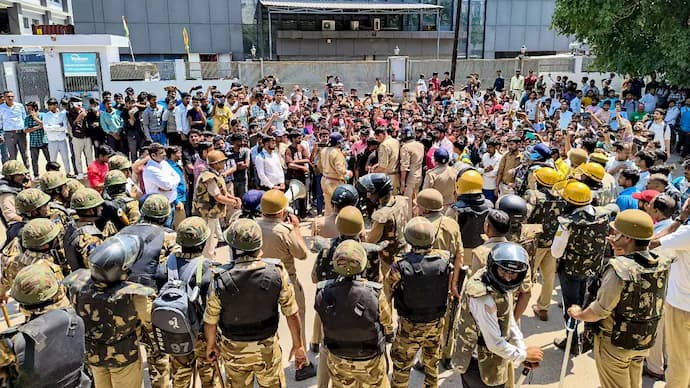
- Violence reported during protests, including stone-pelting and vandalism.
- Notable incident in Noida (April 8, 2026) involved arson and clashes with police amidst demands for a 35% wage increase aligned with the Haryana revision.
- Protests linked to increased living costs, exacerbated by energy crises, with LPG prices rising significantly.
Government and Trade Union Responses:
- Trade unions express frustration over lack of communication with authorities.
- Factory owners report suspension of operations due to safety concerns and demand police protection.
- Protests seen as significant due to their rarity over the past decade.
Economic Implications:
- Increased labor unrest observed in key economic sectors (garments, IT, call centers) highlighting economic strain and potential impacts on manufacturing productivity.
Constitutional Context:
- Workers invoked the right to fair wages under Article 23 (Prohibition of traffic in human beings and forced labour) and Article 39 (Certain directives for policy) of the Indian Constitution.
Future Outlook:
- Workers continue to push for conversations regarding their rights and wage expectations in light of the new labour codes.
- Potential for escalation in industrial action if conversations remain unaddressed.
Overall, these protests reflect a critical moment in India's labor landscape, as workers assert their rights amid economic pressures, highlighting the significance of the Labour Codes and minimum wage policies.
Key Terms & Concepts
| Labour Codes | Regulations for worker rights |
| Haryana Government | Minimum wage revision |
| Rs 15,220.71 | New minimum wage for unskilled |
| Rs 19,42.85 | New minimum wage for highly skilled |
| April 1, 2026 | Effective date of wage increase |
| Code on Wages | One of the Labour Codes |
| Code on Social Security | One of the Labour Codes |
| Industrial Relations Code | One of the Labour Codes |
| Occupational Safety, Health and Working Conditions Code | One of the Labour Codes |
| Employees’ State Insurance Corporation (ESIC) | Social security provisions |
| 3-4 times | Increase in LPG cylinder costs |
| February 2, 2026 | First protest in Barauni |