iAspirants
World's Smallest Programmable Robots Unveiled
Published on:
Share this post
Article Summary
Summary of Microscale Autonomous Robots Development
Research Advancement:
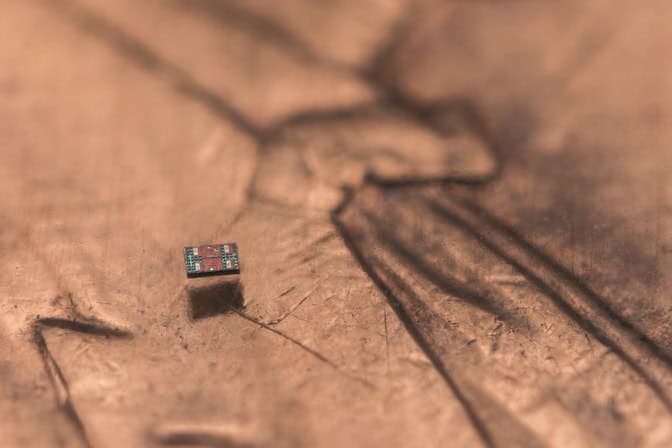
- Researchers at the University of Pennsylvania have created the world’s smallest fully programmable autonomous robots, each measuring approximately 0.2 by 0.3 by 0.05 mm.
- The robots are developed in collaboration with the University of Michigan, leveraging advancements in propulsion and micro-computing technologies.
Capabilities:
- Despite their minuscule size, the robots can:
- Sense their environment.
- Move in complex patterns independently for months.
- Operate with a production cost of about one penny per unit.
Innovations in Movement:
- Movement challenges arise from water's viscosity at microscale, which behaves more like thick tar.
- The robots utilize an electric field to propel themselves by nudging ions in the liquid and manipulating nearby water molecules, eliminating physical moving parts, thereby enhancing durability.
Microprocessing and Power Consumption:
- The robots operate on 75 nanowatts of power, significantly lower than current wearable devices.
- Their surfaces are equipped with solar panels, ensuring energy efficiency.
Programming and Communication:
- Program instructions have been minimized, allowing propulsion control with a single specialized command.
- Each robot bears a unique identifier, enabling distinct task assignments within groups.
- They can sense temperature changes to an accuracy of ±0.33°C and communicate through rhythmic movements, similar to honeybee waggle dances.
Potential Applications:
- Future versions may include improved sensors and capabilities for harsher conditions.
- Possible applications include:
- Monitoring cellular health.
- Assisting in the assembly of microscale devices.
- Enabling advancements in intelligent robotics at microscopic dimensions.
Significance:
- This breakthrough opens a new frontier in computing and robotics, enhancing functionalities at microscopic scales and expanding potential use cases in biotechnology and medicine.
Key Terms & Concepts
| University of Pennsylvania | Developed propulsion system |
| University of Michigan | Created ultra-low-power brain |
| 0.2 by 0.3 by 0.05 mm | Size of the robots |
| 75 nanowatts | Power consumption of robots |
| Pulses of light | Power and programming method |
| Temperature sensors | Precision temperature measurement |
| One-third of a degree Celsius | Sensor precision |
| Electric field | Movement mechanism |
| Solar panels | Power source for robots |
| Microscale devices | Future application of robots |