iAspirants
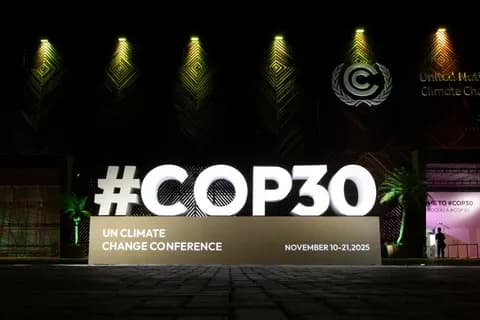
Challenges in Climate Finance at COP 30
Published on:
Share this post
Article Summary
International Climate Negotiations Summary
Paris Agreement Context:
- Annual negotiations on emissions and financial contributions following the Paris Agreement.
- Recent COP discussions held in Belém focused on these objectives but resulted in an unchanged status quo.
Key Issues Addressed:
- Demand for increased climate finance and a “just” transition, notably voiced by India.
- Estimated trillions needed for climate finance; however, effective funding remains uncertain.
Divergent Approaches of Major Economies:
- United States: Abstained from COP 30, announced plans for strategic oil and gas partnerships.
- European Union: Enforcing a Carbon Border Adjustment Mechanism (CBAM) to penalize non-compliance by trading partners, set to commence in January 2026.
Regulatory Outcomes:
- Final COP text emphasized that unilateral trade-based measures should not be arbitrary or discriminatory, signaling a slight win for developing economies.
Market Dynamics:
- The International Energy Agency (IEA) and OPEC have differing short-term oil demand projections, with OPEC expecting higher demand.
- Peak oil demand projections have shifted from 2030 to 2050 as per IEA forecasts, influenced by the US shale boom.
Investment Trends:
- $3.3 trillion invested in the energy sector in 2024, with $2.2 trillion directed towards renewable energy.
- Concerns noted regarding the slowdown in investments from oil-producing nations affecting overall sector investment.
Debt Concerns:
- Advanced economies experiencing high levels of debt, impacting climate finance efficacy.
- Increasing domination of debt in the green finance market, limiting public debt expansion and necessitating alternative capital investment strategies.
India's Position and Recommendations:
- India is urged to establish its emission reduction targets aligning with domestic savings and investment patterns.
- Proposals for carbon pricing to enhance navigation of private finance for climate initiatives.
- The need for pragmatic approaches towards transition finance acknowledged amid unsympathetic responses from developed countries.
Implications for Future Policymaking:
- The COP outcomes highlight complex geopolitical landscapes and the challenges of international consensus.
- Development of frameworks that respect both emission reduction commitments and the economic realities of participating nations.
- Continued monitoring and adjustment of international agreements necessary to ensure equitable climate action and financing.
Key Terms & Concepts
| Paris Agreement | International climate accord |
| COP 30 | Recent climate conference |
| India | Advocated for climate finance |
| EU Carbon Border Adjustment Mechanism | Trade-related tax on carbon |
| IEA | Energy market forecasting |
| OPEC | Oil market forecasting |
| $3.3 trillion | Investment in energy sector (2024) |
| $2.2 trillion | Renewable energy investments (2024) |
| 2026 | Carbon tax implementation date |
| Financial markets | Current economic context |
| Green finance market | Dominated by debt investments |