iAspirants
BRICS Summit Discusses Global Trade Dynamics
Published on:
Share this post
Article Summary
BRICS Summit Highlights: Key Points and Implications
Event Overview
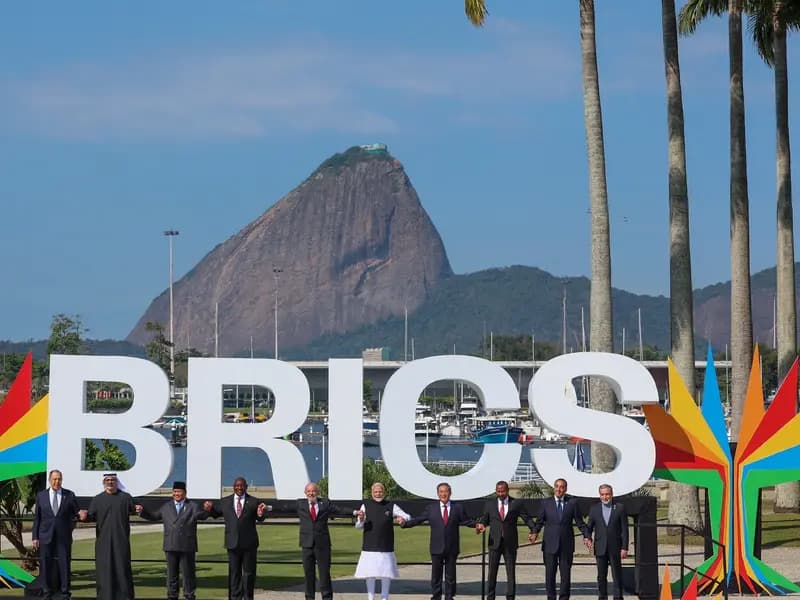
- The 18th BRICS summit is held in India, focusing on the growth prospects of the Global South.
Bilateral Talks
- Significant engagement anticipated between Indian Prime Minister Narendra Modi and Chinese President Xi Jinping.
- Signs of improved relations include:
- Resumption of direct flights.
- Reopening of border trade via the Nathu La Pass.
- Easing of foreign direct investment (FDI) restrictions from land-bordering countries.
Economic Context
- Ongoing global uncertainties (American trade policies, geopolitical tensions) prompting India and China to ease trade tensions.
- India seeks to leverage Section 301 tariff rates to improve its competitive position over other nations, particularly China.
Market Access Discussions
- India aims to address market access issues faced by exporters in China during bilateral talks.
- Potential focuses include:
- Enhancing cross-border investments.
- Collaborations between startups and SMEs.
- Joint strategies to tackle U.S. economic policies and reforms in the World Trade Organization (WTO).
Trade Dynamics
- BRICS collaboration necessary to tackle heavy trade dependence on China, especially within MSMEs (Micro, Small, and Medium Enterprises).
- India faces a significant trade deficit with China, particularly in sectors such as electronics, garments, and automobiles.
- In 2023, China accounted for 19.2% of India’s total imports, indicating a critical dependency.
BRICS Contributions
- Potential for BRICS to enhance India's access to:
- Critical minerals.
- Energy technologies and capital.
- New partnerships in manufacturing.
- Emphasis on creating efficient trade and investment corridors and strengthening SME collaborations.
- Potential for BRICS to enhance India's access to:
Challenges Ahead
- Indian manufactures face competitiveness against Chinese products due to China's dominance and reliance on exports.
- Reports suggest that China remains integral to labor-intensive manufacturing, complicating global supply chain dynamics.
- U.S. treasury report warns that China's economic model is unsustainable, which may have global repercussions.
International Agreements and Collaborations
- Discussions may cover improving mechanisms for trade, payment, and investment within BRICS nations, focusing on:
- Faster cross-border settlements.
- Easier recognition of standards.
- Strengthening buyer-seller networks.
- Discussions may cover improving mechanisms for trade, payment, and investment within BRICS nations, focusing on:
Implications for Global South
- Both nations acknowledge mutual stakes in the resilience of Global South countries.
- A push for multilateralism is expected to shape future diplomatic engagements.
Constitutional References
- No specific constitutional articles were referenced directly in the context but implications for trade agreements may relate to Articles governing economic policy and international relations.
This summit marks a pivotal moment for redefining India-China relations amidst a complex global trade landscape. The outcomes may shape future cooperation among BRICS nations and address ongoing challenges in international trade.
Key Terms & Concepts
| BRICS | Group of emerging economies |
| Nathu La Pass | Border trade route reopening |
| Foreign Direct Investments (FDI) | Easing restrictions from neighbors |
| Section 301 rates | Tariff negotiations with US |
| New Development Bank | Funding cross-border projects |
| Institute for Studies in Industrial Development (ISID) | Reported India-China trade deficit |
| 19.2% | Percentage of imports from China |
| China | Largest import origin for India |
| US Treasury report | Analysis of China's economic model |
| 60 percent | Global trade surplus share by China |
| 2024 | Referencing future economic projections |