iAspirants
Current AffairsPrelims PYQsUPSC CSE SyllabusUPSC CSE StrategyBlogsPricing
Login
iAspirants

Your AI-powered companion for UPSC preparation.

Quick Links

  • Home
  • About Us
  • Current Affairs
  • Prelims PYQs
  • UPSC CSE Syllabus
  • UPSC CSE Strategy
  • Blogs

Company

  • Pricing
  • FAQs
  • Contact Us
  • Login

Legal

  • Privacy Policy
  • Terms & Conditions
  • Return Policy

© 2025 iAspirants, Inc. All rights reserved.

  1. Blogs
  2. History

Chola Dynasty's Maritime Trade Connections

Published on: 17-Oct-2026

Source: Indian Express

Share this post
Chola Dynasty's Maritime Trade Connections

Article Summary

Key Highlights on Chola Dynasty's Maritime Trade and Influence

Historical Context:

  • Dynasty Overview: The Chola dynasty was one of the significant powers in South India from the 9th to 13th centuries, ruling over areas including present-day Tamil Nadu.
  • Key Rulers: Significant figures included Rājarāja I (r. 985-1014), Rājēndra I (r. 1014-1044), and Rājadhirāja I (r. 1044-1052).
  • Trade Influence: The Cholas played a pivotal role in expanding both domestic and international trade networks during this period, particularly with regions in Southeast Asia.

Excavation Findings:

  • Excavation Site: Poompuhar, Tamil Nadu.
  • Artifacts Found: West Asian "torpedo jar," terracotta ring wells, and over 250 ceramic fragments, indicating maritime connections with West Asia and the Mediterranean.
  • Torpedo Jar Functionality: Historically used for transporting liquid cargo (e.g., wine, olive oil).

Trade Dynamics:

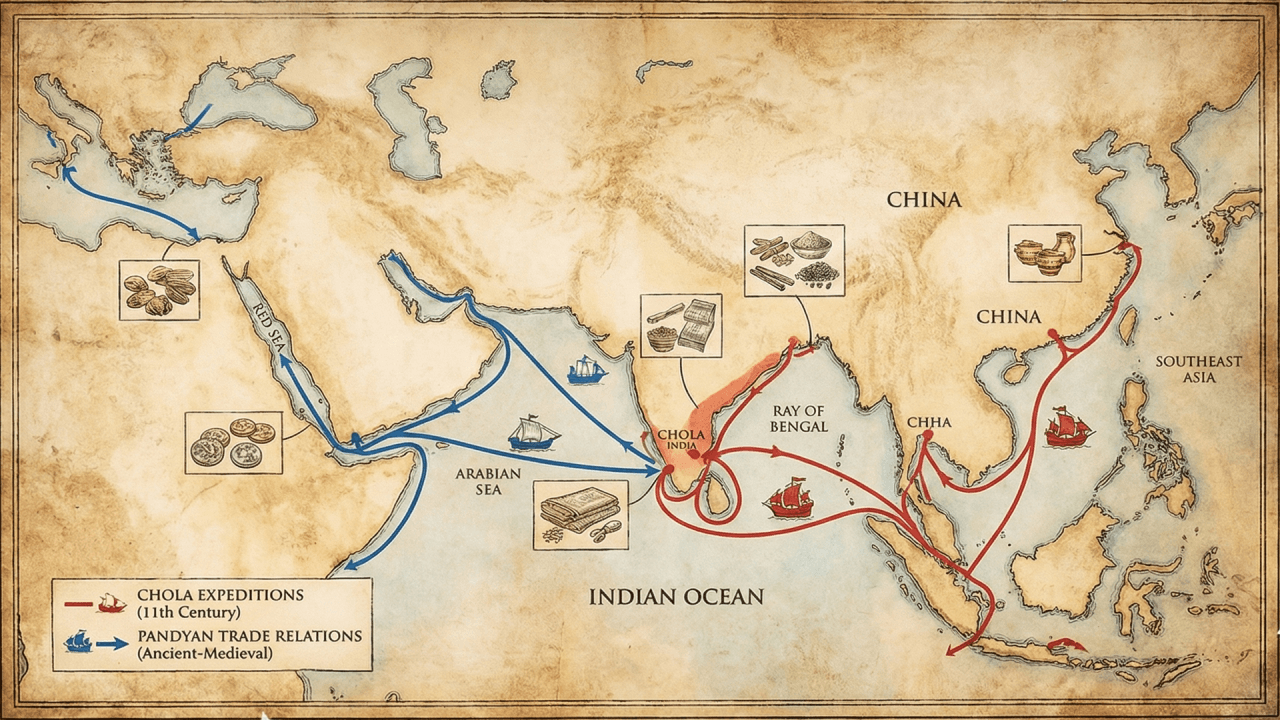
  • Goods Traded: Included textiles, spices, rice, grains, sandalwood, camphor, pearls, ivory, precious stones, and Arab horses.
  • Trade Missions: Notable trade missions included one to China in 1015 CE and additional subsequent missions, highlighting the significance of East and Southeast Asia in Chola trade.

Economic Organization:

  • Commercial Towns: Key economic centers known as nagaram facilitated trade and created strategic partnerships with merchant communities and religious institutions.
  • Temple Urbanization: Religious institutions, particularly Brahmanical temples, became crucial in stimulating urban growth and economic activity through their demand for goods and services.

Merchant Guilds:

  • Guild Association: Prominent guilds such as Ainurruvar, Manigramam, Nanadesi, and Anjuvannam dominated the economic landscape from the 9th to mid-14th centuries.
  • State and Guild Relationship: A mutual arrangement where the state provided protection and favorable trade terms, while guild members contributed to the upkeep of temple properties and supported royal endeavors.

Cultural Exchange:

  • Spread of Religion and Culture: Maritime trade facilitated cultural and religious exchanges, notably spreading Buddhism and Brahmanism throughout Southeast Asia.
  • Tamil Inscriptions: Evidence of Tamil inscriptions in China and the establishment of Hindu temples in Southeast Asia indicates strong cultural ties.

Economic Indicators:

  • Revenue from Trade: Customs duties from trade were crucial for Chola economic budgets, with thriving port towns indicating robust overseas commerce despite debates on trade taxation.

Strategic Trade Developments:

  • Emergence of Maritime Silk Route: The Cholas shifted trade patterns from overland routes to maritime ones, establishing significant trade connections across the Indian Ocean and strengthening ties with ports such as Palembang, Nagapattinam, and Muziris.

Contemporary Significance:

  • Legacy: The Chola dynasty's trade networks contributed to the formation of a “world economy,” integrating various maritime markets and fostering cultural exchanges across Asia.

These highlights reflect the Chola dynasty's profound influence on trade and cultural exchanges which have laid the groundwork for understanding historical economic systems in South Asia and their impact on regional connectivity.

Key Terms & Concepts

PoompuharExcavation site for trade evidence
CholasDynasty known for overseas trade
torpedo jarUsed for transporting liquids
Brihadesvara templeSignificant temple showcasing wealth
Kaveri deltaAgricultural and economic wealth source
AinurruvarMerchant association in Chola period
Srivijaya kingdomTrade partner with Cholas
1015 CEYear of trade mission to China
Indian OceanTrade route for Chola goods
Greater IndiaCultural and religious influence area
Chinese porcelainImportant traded commodity
customs dutiesSource of revenue for trade

Mind Map for UPSC Civil Services Revision

Turn UPSC Civil Services Current Affairs Into Exam-Ready Notes

Reading History current affairs is half the work. Revise them with ready-made notes and test what actually stuck.

  • Daily UPSC Civil Services current affairs analysis
  • Revision notes, mind maps & MCQs
  • Prelims mock tests with instant results

Related UPSC Civil Services Current Affairs Articles

Gandikota: Heritage and Tourism Development
Environment and Ecology17-Oct-2026

Gandikota: Heritage and Tourism Development

Summary of Key Points on Gandikota

Geographical and Geological Significance

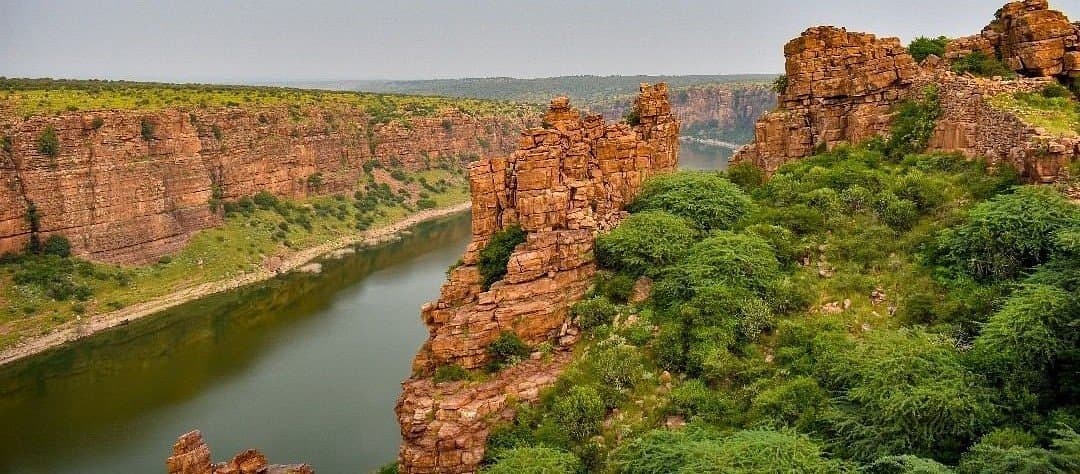
  • Location: Gandikota, Jammalamadugu Mandal, Kadapa District, Andhra Pradesh.
  • Nickname: Known as the "Grand Canyon of India."
  • Formation History: Geological processes have shaped the area over an estimated 1.2 billion years, revealing sedimentation and tectonic shifts.
  • Characteristics: Features approximately 300 feet high cliffs made of red sandstone and quartzite, with the Penna River winding below.
  • Historical Context

    • 12th-Century Fort: Linked to the Kakatiya dynasty and the Vijayanagara Empire, showcasing ancient defensive architecture and temples.

    Tourism Development Initiatives

    • Government Support: The Andhra Pradesh government is developing Gandikota as a tourism hub.
    • Funding: ₹77.91 crore sanctioned under the Union government's tourism development scheme titled “Enriching the Fort and Gorge Experience in Gandikota.”
    • Gandikota Festival: Recently organized to promote local culture and boost economic activities in the region.

    Environmental and Conservation Concerns

    • Potential UNESCO Recognition: There are calls to recognize Gandikota as a UNESCO World Heritage site, which would require focused efforts for geological preservation.
    • Tourism Impacts: Increase in visitors has led to littering and environmental degradation due to poor waste management and construction activities near sensitive zones.
    • Proposed Solutions:
      • Master Planning: Need for a comprehensive plan addressing the balance between tourism and conservation.
      • Sustainability Practices: Implementation of marked trails, building restrictions, controlled camping, and inclusion of trained local guides.

    Recommendations by Experts

    • Dr. P. Ravi Raju (Central Archaeology Department): Advocates a master plan treating the gorge and fort as a cohesive ecosystem.
    • P. Venkataratnam, Real Estate Agent: Emphasizes on marked walking trails, strict zoning laws, and improved public amenities.
    • Community Engagement: Involving local communities in tourism decisions to promote sustainable practices.

    Conclusion

    • Responsible Tourism: Gandikota has potential to become an exemplary model for sustainable tourism, encouraging responsible behavior from visitors and benefitting the local economy.

    Importance of Geological and Historical Heritage

    • Local conservationists argue for deeper appreciation of Gandikota beyond its scenic appeal, seeking to establish it as a valuable educational and ecological site.
    Historical Landscape of Rayalaseema
    Indian and World Geography17-Oct-2026

    Historical Landscape of Rayalaseema

    Geological and Historical Significance of Rayalaseema, Andhra Pradesh

    1. Geological Overview:

      • Rayalaseema is part of the ancient Dharwar Craton and Cuddapah Basin, with geological formations over 2.5 billion years old.
      • Rich in geological features like the Eparchaean Unconformity, representing key historical shifts in Earth's geology, showcasing a billion-year gap in Earth's history.
    2. Key Geological Features:

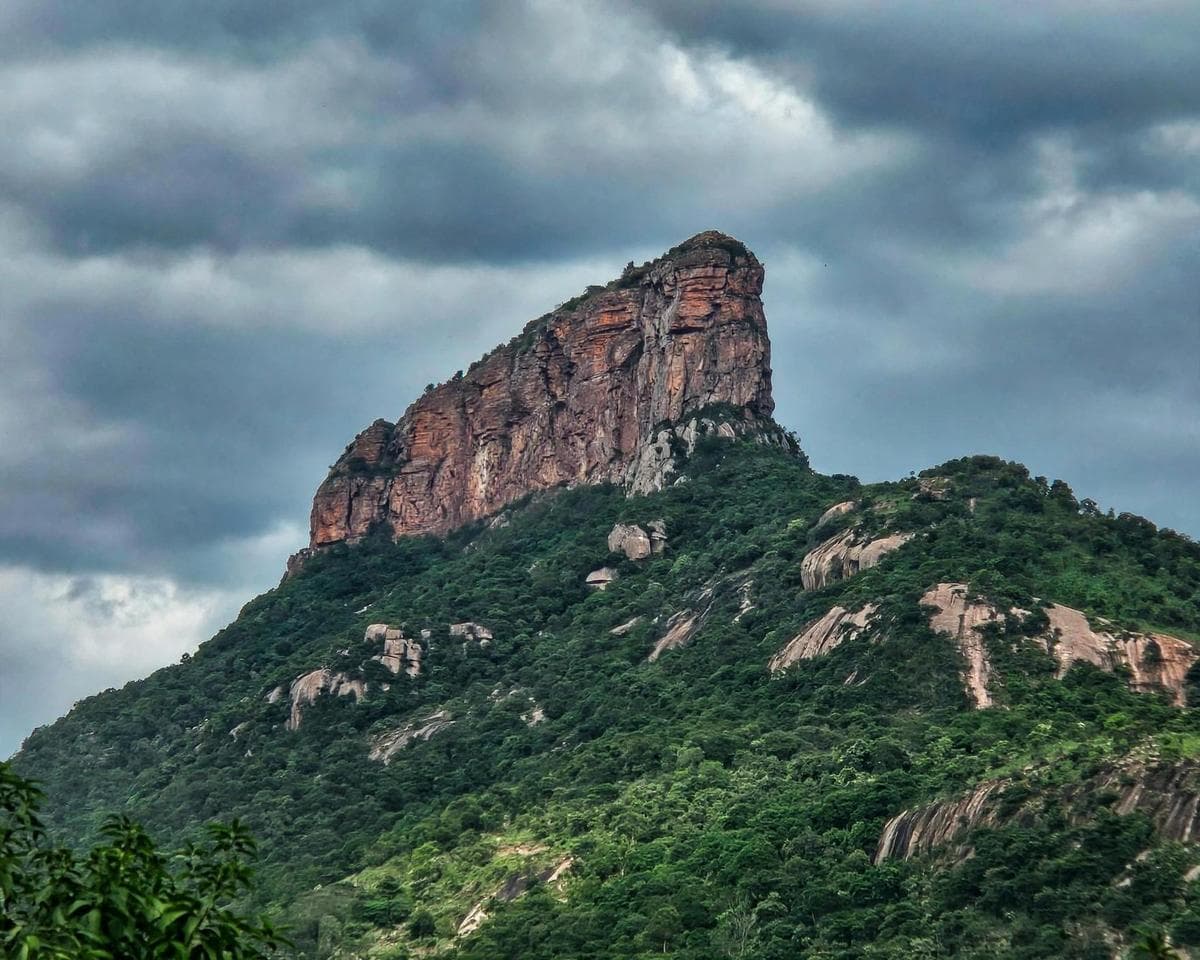
      • Nagari Hills: Formed 1.5 billion years ago, these hills comprise ultra-hard quartzite and granite, strategically important during historical conflicts.
      • Moghili Ghat: Dating about three billion years, obliterated for highway construction, exemplifying threats to geological formations.
    3. Environmental and Biodiversity Issues:

      • The region hosts unique flora and fauna, e.g., the Red Sanders tree and the endangered Jerdon’s Courser, adapted to the harsh, mineral-rich environments.
      • The Golden Gecko is restricted to Seshachalam Hills, demonstrating the region's ecological uniqueness.
    4. Impact of Human Activities:

      • Unregulated quarrying, construction, and tourism threaten geological structures and biodiversity.
      • Instances of significant geological formations being compromised for infrastructure, such as road expansions and quarrying operations leading to irreversible damage.
    5. Cultural and Religious Significance:

      • Sites like the Yaganti temple amalgamate geological formations with cultural heritage, showcasing the intersection of natural and human history.
      • Traditional practices continue to validate the spiritual significance of sites, e.g., pujas performed atop Nagari Nose.
    6. Conservation Efforts and Proposals:

      • Demand for UNESCO Global Geopark status to protect geological sites while promoting responsible tourism and heritage education.
      • Proposals include establishing regulated tourist zones and educational initiatives to enhance the understanding and appreciation of unique geological features.
    7. Judicial/Policy Advocacy:

      • Recommendations for government and officials to recognize the geological importance and take action to preserve these irreplaceable sites against industrial and urban encroachment.
    8. Scientific Research:

      • Contribution to geological science through ongoing studies by local universities, highlighting the region’s role in understanding Earth's history and structure.
      • Suggestions for employing scientific insights into developing strategies for sustainable tourism and conservation.
    9. Future Directions:

      • The integration of conservation with modern developmental strategies is critical; perspectives encourage a balanced approach toward development, conservation, and education.
      • Urgent call for stakeholder involvement, including local communities, government, and scientific bodies, to collaboratively manage the region's ecological and historical wealth.
    10. Economics and Society:

      • The potential for heritage tourism to positively impact local economies while ensuring the protection of both cultural and natural resources.
      • Addressing human-wildlife conflicts resulting from habitat disruption caused by infrastructural development.

    These points underscore the critical need for preserving Rayalaseema's intricate geological and cultural tapestry amid modernization, which threatens its unique heritage and ecological richness.

    Supreme Court Decision on Caste Reservation
    Polity and Governance17-Oct-2026

    Supreme Court Decision on Caste Reservation

    Supreme Court Ruling on Reservation for Converts

    Case Overview:

    • The Supreme Court upheld the Madras High Court's ruling that a person converting from Hinduism to Islam cannot claim reservation under the Backward Class (Muslim) category based solely on conversion.
    • The decision involved a man who converted to Islam and sought certification as a "Muslim Lebbai", classified under Tamil Nadu's backward classes, which offer a 3.5% reservation as per the 2007 State Act.

    Legal Background:

    • The Constitution's Article 16(4) allows for affirmative action for backward classes, but the Court ruled that conversion does not carry over social backwardness from a person's previous religion.
    • The ruling emphasized that the legal identity as a Scheduled Caste is tied to the religion professed, as per:
      • Article 341: Defines Scheduled Castes (SC) under the Constitution (Scheduled Castes) Order, 1950.
      • Article 366(24): Defines SCs as those notified by the President.

    Judicial Findings:

    • Conversion to a non-Hindu religion results in the loss of SC status and does not automatically confer membership to a backward community of the new religion.
    • The Court reiterated that reservation benefits are not personal entitlements but attached to constitutionally identified classes.
    • The High Court's examination of the state government order (GO) was justified as it was central to the relief sought.

    Process and Implications:

    • The Court rejected the state's argument that the GO merely preserved pre-conversion benefits.
    • Clarified that Muslim communities specified as backward in Tamil Nadu arise from social history rather than theological denominations.
    • The judgment underscores the importance of maintaining a distinction between community status and religious affiliation.

    Conclusion:

    • The Supreme Court ruling delineates the specific legal frameworks pertinent to caste-based reservations, reinforcing that conversion impacts eligibility for state-sponsored affirmative action.
    • This ruling could influence future applications related to caste status and affirmative action claims for converted individuals across India.

    Constitutional Articles Referenced:

    • Article 16(4): Provides for reservations for backward classes.
    • Article 341: Details protocols concerning Scheduled Castes.
    • Article 366(24): Further defines Scheduled Castes in alignment with Article 341.

    Judicial Impact:

    • The ruling will likely have wider implications on similar cases involving religious conversion and caste-based reservations, setting a precedent on the socio-legal intersection of religion and social identity.
    Conservation Threats to Jeypore Gecko
    Biodiversity15-Oct-2026

    Conservation Threats to Jeypore Gecko

    Jeypore Ground Gecko: A Case Study on Conservation and Biodiversity

    Species Overview:

    • Jeypore Ground Gecko (Cnemaspis jeyporensis): Rediscovered in 2010 after being presumed extinct for 130 years.
    • Size: Approximately 3.6 inches long, characterized by a yellow-orange body and large head.
    • Geographical location: Primarily located in the Eastern Ghats, particularly in Odisha and Andhra Pradesh.

    Recent Findings:

    • Only four individuals documented in 2025 and three more sightings in 2026, raising concerns about the species' survival.
    • Species is endangered, largely due to habitat loss.

    Habitat Threats:

    • The gecko's habitat is declining due to:
      • Bauxite mining: Notably associated with the Adani Group’s proposed opencast mining project covering 147 hectares in the Balda hills, part of the Nageswari reserve forest.
      • Transformation of forests into coffee plantations and hydropower projects.

    Historical Insight:

    • Original description of the species by Richard Henry Beddome in 1878.
    • Habitat where first documented (Potangi, Odisha) lost to mining activities by the National Aluminium Company Limited (NALCO).

    Community Impact:

    • The local Adivasi communities (Bondo and Porja) oppose the mining proposal, claiming ancestral rights over the land.
    • Communities applied for forest rights, which have been denied by the government. They have been actively protesting against mining activities, including stopping drone surveillance by the Adani Group.

    Ecological Significance:

    • Ishan Agarwal, the ecologist who rediscovered the gecko, highlights its ecological and biogeographical importance as it split from its relatives over 20 million years ago.
    • The Balda hills are home to a wealth of biodiversity including unique species like the Gegeneophis orientalis (limbless amphibian).

    Conservation Recommendations:

    • Romulus Whitaker, a renowned herpetologist, emphasizes the urgent need to prioritize biodiversity conservation in the area, particularly for the Jeypore ground gecko and other related species.
    • Strong opposition to mining activities is urged to protect this flagship species and its habitat.

    Conclusion: The plight of the Jeypore ground gecko reflects broader environmental and social issues surrounding resource extraction in ecologically sensitive areas. Conservation efforts are critical to safeguard not only this unique species but also the rights of indigenous populations dependent on the land. Addressing these challenges requires a collaborative approach that respects ecological integrity and community rights.

    Debate Over Angioplasty Necessity
    Health and Medical Procedures09-Oct-2026

    Debate Over Angioplasty Necessity

    Summary Notes on Angioplasty Debate in Kerala

    Key Issues:

    • Kerala Chief Minister V D Satheesan expresses concerns over the necessity of angioplasty procedures, suggesting that some hospitals perform them without medical need.
    • The Indian Medical Association (IMA) acknowledges the importance of avoiding unnecessary medical procedures while cautioning against sweeping statements that could undermine trust in medical professionals.

    Angioplasty Overview:

    • Angioplasty is a procedure that opens blocked heart arteries, often involving the placement of a stent to ensure blood flow.
    • It is critical during acute heart attacks but may not provide additional benefits for patients with stable coronary artery disease, as multiple studies indicate limited need for such interventions unless there are severe blockages.

    Statistics and Data:

    • Kerala is ranked third in coronary stent usage in India, following Maharashtra and Karnataka, as per National Interventional Council data.
    • A coronary artery blockage generally requires at least 70% narrowing (or 50% in critical areas) before stenting is deemed necessary.

    Clinical Guidelines:

    • Decisions on angioplasty must be individualized, considering the patient's clinical condition, test results, and risk factors.
    • Testing procedures vary with risk estimation based on patient demographic and symptomatic history (age, sex, symptoms).

    Patient Anxiety and Perception:

    • Patients often face anxiety and are affected by misinformation about angiograms, leading to difficulty in interpreting results.
    • Trust issues can arise if patients feel procedures are being pushed unnecessarily, causing them to delay life-saving interventions during heart attacks.

    Educational Focus:

    • It is suggested that public messaging should clarify the need for angioplasty targeting the right patients rather than general avoidance.
    • Importance of informed decision-making where patients understand the rationale for procedures and are included in discussions about their treatment options.

    Recommendations for Best Practices:

    • Emphasize the importance of shared decision-making between doctors and patients.
    • Instituting public awareness campaigns regarding when urgent intervention is necessary and the risks/alternative treatments available.
    • Clinical audits recommended through proper medical bodies to ensure adherence to evidence-based medical practices.

    Conclusion

    The discourse surrounding angioplasty in Kerala raises significant questions about medical necessity and the associated psychological effects on patients. Emphasizing informed consent, clear communication, and adherence to clinical guidelines is essential for the appropriate use of such interventions.