iAspirants
Current AffairsPrelims PYQsUPSC CSE SyllabusUPSC CSE StrategyBlogsPricing
Login
iAspirants

Your AI-powered companion for UPSC preparation.

Quick Links

  • Home
  • About Us
  • Current Affairs
  • Prelims PYQs
  • UPSC CSE Syllabus
  • UPSC CSE Strategy
  • Blogs

Company

  • Pricing
  • FAQs
  • Contact Us
  • Login

Legal

  • Privacy Policy
  • Terms & Conditions
  • Return Policy

© 2025 iAspirants, Inc. All rights reserved.

  1. Blogs
  2. Polity and Governance

Evolution of India's Election Commission

Published on: 04-Oct-2026

Source: Indian Express

Share this post

Evolution of India's Election Commission

Article Summary

Key Facts and Constitutional References

  1. T.N. Seshan's Tenure:

    • Appointed as Chief Election Commissioner (CEC) in December 1990.
    • Focused on increasing the Election Commission's prominence and autonomy in electoral matters.
  2. Constitutional Framework:

    • Article 324: Establishes the CEC and allows for additional Election Commissioners as determined by the President of India.
    • CEC's removal is protected under the same grounds as a Supreme Court judge, while other Election Commissioners can be removed based on the CEC’s recommendation.
  3. 1993 Ordinance:

    • On October 1, 1993, an ordinance was issued allowing for the appointment of two additional Election Commissioners (M.S. Gill and G.V.G. Krishnamurthy).
    • Decisions within the commission to be made by majority if unanimity was not achieved.
  4. Judicial Rulings:

    • In January 1990, the Supreme Court ruled that while the CEC's position was constitutional, the addition of other Election Commissioners was not obligatory.
    • The court interpreted Article 324 and ultimately upheld the 1993 ordinance in July 1995.
    • The ruling stated that the CEC's superior protection from removal does not equate to superior decision-making authority.
  5. Constitution Bench Outcomes:

    • A five-judge Constitution Bench, led by Chief Justice A.M. Ahmadi, established that the stronger protection for the CEC serves institutional independence rather than enhanced voting power.
    • The CEC is seen as 'primus inter pares' (first among equals) within the commission.

Relevant Historical Context

  • For much of India's history, the Election Commission functioned with only one member (the CEC).
  • A brief period of multi-member status existed in 1989 before reverting to single-member status, leading to challenges in authority and hierarchy.

Institutional Impact

  • Seshan’s efforts in elevating the Election Commission’s visibility led to debates about authority and collective decision-making.
  • The eventual Supreme Court decision reinforced that the commission’s strength lies in its collective functioning rather than the authority of a single office-holder.

Recent Implications

  • The historical context of Seshan's challenges and the Court's rulings have become relevant once again in contemporary discussions about the Election Commission's internal differences, underscoring the significance of collegial decision-making within constitutional frameworks.

Summary Notes

  • Seshan's tenure was marked by efforts to establish a strong, independent Election Commission but also highlighted the complexities of authority within the commission.
  • The Supreme Court rulings on the nature of the CEC's powers continue to influence the functioning of the Election Commission today, emphasizing institutional independence and collective decision-making.

Key Terms & Concepts

Article 324Defines Election Commission structure
October 1, 1993Date of ordinance issuance
Supreme CourtJudicial authority in case
January 4, 1994Legislation replacing ordinance
July 1995Date of Supreme Court judgment
Nirvachan SadanSeat of Election Commission
Constitutional BenchCourt's adjudicating body
Primus inter paresDecision-making principle established

Mind Map for UPSC Civil Services Revision

Turn UPSC Civil Services Current Affairs Into Exam-Ready Notes

Reading Polity and Governance current affairs is half the work. Revise them with ready-made notes and test what actually stuck.

  • Daily UPSC Civil Services current affairs analysis
  • Revision notes, mind maps & MCQs
  • Prelims mock tests with instant results

Related UPSC Civil Services Current Affairs Articles

Child Safety and Judicial Awareness
National and International Importance04-Oct-2026

Child Safety and Judicial Awareness

Summary of Key Points:

  1. Judicial Ruling and POCSO Act:

    • The Delhi High Court addressed a case involving a minor rape survivor who identified her abuser as “uncle.”
    • The court emphasized the importance of the child’s testimony and awarded compensation, stating it cannot restore her childhood but acknowledges her courage.
  • Relevant laws:
    • Protection of Children from Sexual Offences (POCSO) Act, particularly Sections 4 (penetrative sexual assault) and 6 (aggravated penetrative sexual assault).
  • National Crime Records Bureau Statistics:

    • In the 2024 report, of 44,126 reported cases under POCSO, only 1,492 cases involved an unidentified offender. This highlights issues of accountability and societal implications regarding child sexual abuse.
  • Childhood Trauma:

    • Research indicates that childhood trauma can lead to insecure attachments and emotional issues in adulthood. Such findings suggest a long-term impact on victims of sexual assault.
  • Societal Attitudes and Gender Perception:

    • The cultural response to incidents of sexual assault varies, with a notable infantilization of girl victims and disbelief towards their accounts compared to boy victims.
    • There is a call to examine the gendered lens through which society views and addresses crimes against children.
  • Need for Preventative Measures:

    • The narrative urges a societal shift from teaching children how to avoid violence to instituting societal frameworks aimed at preventing violence against women and children.
    • It underscores the necessity for educational reforms and policy changes that empower both genders and ensure safety in public and private spaces.
  • Constitutional Context:

    • The incident and related rulings raise concerns regarding Articles in the Constitution of India that pertain to the protection of children (Article 39(e) and 39(f) regarding children’s rights), highlighting the need for stricter enforcement and societal change.
  • Mindset and Cultural Change:

    • The article advocates for a societal handbook that addresses prevention rather than victim-blaming, implying a significant cultural shift is necessary to properly address these issues.
  • These points outline the serious implications of child sexual abuse, the systemic issues surrounding judicial accountability, cultural perceptions, and the need for comprehensive change in both policy and societal attitudes.

    Digital News Publishers Ethics Code
    Polity and Governance04-Oct-2026

    Digital News Publishers Ethics Code

    Digital News Publishers Association - Code of Ethics Summary

    Objective:

    • To outline high standards and ethical practices in digital news publishing, ensuring adherence to the Constitution of India and relevant laws.

    Constitutional References:

    • Article 19(1)(a): Right to freedom of speech and expression, safeguarding the gathering and dissemination of news.

    Legal Framework:

    1. Constitution of India: Requires compliance with laws governing media operations.
    2. Information Technology Act, 2000: Regulates online content and outlines responsibilities for digital publishers.
    3. Additional Relevant Laws: More than 30 laws related to media, including IPC and CrPC.

    Ethical Standards:

    • Accuracy, Transparency & Fairness:
      • Mandatory pre-publication verification; avoiding defamation and publishing of false information.
    • Right of Reply:
      • Inclusion of responses from individuals or parties involved in news reports.
    • Content Correction:
      • Mechanism for editing, deleting, or taking down inaccurate reports upon verified request.

    Intellectual Property Rights:

    • Obligations to respect copyright and trademark laws, including obtaining prior permission for usage and acknowledging ownership.

    Reporting Guidelines:

    • Careful reporting on sensitive matters such as:
      • Sexual harassment
      • Child abuse
      • Matrimonial cases
      • Communal disputes
    • Adherence to Sections 67, 67A, and 67B of the IT Act, which impose penalties for distributing obscene or explicit content.

    Grievance Redressal:

    • Compliance with the grievance mechanism under the IT Act, including appointing grievance officers and timely resolution of complaints within specified timeframes.

    Training and Awareness:

    • Regular training for editorial staff concerning:
      • Existing laws (including the Constitution and various media regulations).
      • Best practices in reporting sensitive topics, preserving privacy, and ensuring communal harmony.

    Protecting Journalistic Integrity:

    • Emphasis on editorial independence while fostering transparency and accountability in the reporting process.
    • Standards to maintain fairness and uphold the dignity and privacy of individuals involved in reported cases.

    This Code of Ethics serves as a self-regulatory initiative aimed at enhancing responsible journalism and protecting constitutional rights while ensuring the credibility and integrity of digital news publishers.

    Unrest at Punjab Universities Explained
    Polity and Governance04-Oct-2026

    Unrest at Punjab Universities Explained

    Summary of Events and Legal as well as Institutional Responses in Punjab Universities

    Key Events:

    1. Unrest Trigger:

      • Late September 2023, Chitkara University and Lovely Professional University (LPU) in Punjab witnessed violent protests due to unfounded rumors about student suicides and rapes that spread rapidly on social media.
    2. Chitkara University Incident:

      • Date of Incident: September 25-26
      • Allegation: Claims of two female student suicides and disposal of their bodies.
      • Protests resulted in vandalism of police vehicles and assault on officers.
      • Police findings: The rumors were reportedly baseless, identified as a prank.
      • Arrests: Two former students arrested for inciting the unrest through rumor-mongering.
    3. LPU Incident:

      • Date of Incident: September 26-27
      • Allegation: Claims of rape of a female student in a hostel.
      • Protesters damaged property, blocked National Highway-44, demanding an FIR.
      • Legal Action: FIR registered under Section 64 (rape) of the Bharatiya Nyaya Sanhita, 2023; police could not identify the alleged victim.
      • Escalation: Clashes with police led to use of lathi charge; news of arrests increased to nine.

    Legislative and Policy References:

    1. Bharatiya Nyaya Sanhita (BNS), 2023:

      • Legal framework under which FIRs were filed for rape and related offenses.
      • Specific Sections:
        • Section 64: Rape
        • Section 326(g): Arson
        • Section 324(4): Property damage
        • Section 4: Punjab Prevention of Damage to Public and Private Property Act, 2014, regarding property damage during protests.
    2. High Court Proceedings:

      • The Punjab and Haryana High Court is monitoring the situation and has requested a status report from the Punjab government regarding the violence at LPU, in response to a petition for a CBI probe into the incidents.

    Institutional Responses:

    1. Chitkara University:

      • Officially dismissed suicide rumors as false and misleading.
    2. LPU's Defense:

      • Claimed the spread of false rumors orchestrated by “anti-social elements.”
      • Featured a video from three students denying the rape incident, attempting to clarify the situation.

    Societal Reactions:

    • The incidents reflect broader issues regarding the sensitivity of mental health, campus safety, and the rapid impact of social media misinformation.
    • Tensions possibly exacerbated due to previous political affiliations and rivalries, as indicated by comments from local political figures.

    Implications:

    • The incident highlights the dire need for vigilant verification of information circulated on social media, especially in volatile situations among youth.
    • Legal and police systems are under scrutiny regarding their rapid response and handling of mob violence and public safety during university protests.
    • Potential judicial involvement signifies an increasing emphasis on addressing student grievances and ensuring campus security in Punjab’s private educational institutions.

    Conclusion:

    These events in Punjab universities underscore a pressing need for policies that enhance public safety, improve crisis management protocols, and mitigate misinformation, especially among vulnerable populations such as students. The legal framework surrounding crimes and public disorder, as observed from the responses, must adapt to effectively address such emergent situations.

    Debate Over Poverty Definition in J&K
    Polity and Governance03-Oct-2026

    Debate Over Poverty Definition in J&K

    Summary of Key Points from Jammu and Kashmir Assembly Discussion on Poverty and Reservation

    Context

    • The discussion centers around conflicting definitions and data representing poverty in Jammu and Kashmir (J&K), particularly regarding the Economically Weaker Sections (EWS) and their representation in job reservations.

    Constitutional and Legislative Framework

    • The J&K Reservation Rules were amended in March 2024 to increase government job reservations:
      • Scheduled Tribe (ST) quota raised from 10% to 20%.
      • Overall job reservation increased from 43% to approximately 70%, leaving 30% for open merit candidates.

    Economic and Social Indicators

    • A stark difference in poverty distribution has been highlighted, with the current EWS definition indicating:

      • 92% of EWS certificates issued are from the Jammu region.
      • Only 8% are from the Kashmir region.
    • In contrast, when considering Priority Household (PHH) and Antyodaya Anna Yojana (AAY) ration cards, poverty distribution reflects:

      • 37.71 lakh PHH/AAY cards in Kashmir versus 29.81 lakh in Jammu.
      • This indicates 55% of the poor may reside in Kashmir compared to 45% in Jammu.

    Government Actions and Responses

    • The Handwara MLA, Sajad Lone, raised questions regarding the accuracy and fairness in the representation of poverty through the EWS framework.

    • Reported statistics on job vacancies:

      • 7,580 job vacancies filled in the past two years, with 10% (758 jobs) reserved for EWS candidates.
      • Under EWS criteria, allocation shows a disproportionate distribution of jobs among the regions, projecting 697 jobs to Jammu and only 61 to Kashmir.
    • Anticipated filling of 49,672 additional vacancies:

      • EWS reservation at 10% would imply 4,967 jobs, with projected allocations favoring Jammu (4,569 jobs) significantly over Kashmir (398 jobs).
      • By PHH/AAY card criteria, the expected distribution would be 2,235 jobs for Jammu and 2,732 for Kashmir.

    Protests and Committees

    • Open-merit students have protested against the current quota system.
    • A Cabinet sub-committee was formed to analyze the reservation policy, recently suggesting a reversal to a 50:50 split between reserved and open merit categories, particularly suggesting reductions under RBA and EWS categories.

    Additional Observations

    • MLA Lone indicates a need for a uniform definition of poverty to accurately represent the socio-economic realities in J&K and better inform policy decisions.
    • The ongoing debate emphasizes a systemic issue reflected in job allocation based on varying definitions of economic status.

    Conclusion

    The discussion highlights significant disparities in the identification of economically weaker populations in J&K and raises questions regarding the fairness of reservation policies. The implications of such disparities are critical in shaping social equity and resource allocation within the region.

    Debate Over National Song Laws
    Polity and Governance02-Oct-2026

    Debate Over National Song Laws

    Exam-Focused Notes on National Song 'Vande Mataram' Legislation and Judicial Context

    Constitutional & Legal Aspects

    • Prevention of Insults to National Honour Act, 1971: Recently amended to incorporate 'Vande Mataram' as a song under criminal law.
    • Supreme Court Case: T.M. Krishna challenged the amendments; the court is set to review the implications of forcing adherence to the song. Justice Bagchi cited the Bijoe Emmanuel vs. State of Kerala ruling, asserting that a conscientious objector should not face criminal consequences for refraining from singing.

    Key Legal Points

    • Right to Dissent: The court emphasized that the state can decide the official version of the song, but individual rights to religious freedom and peaceful objection must be respected.
    • Judicial Precedents & Interpretations: Justice Bagchi’s comments underscore that the law must protect individual liberties while balancing national sentiments.

    Historical Background of 'Vande Mataram'

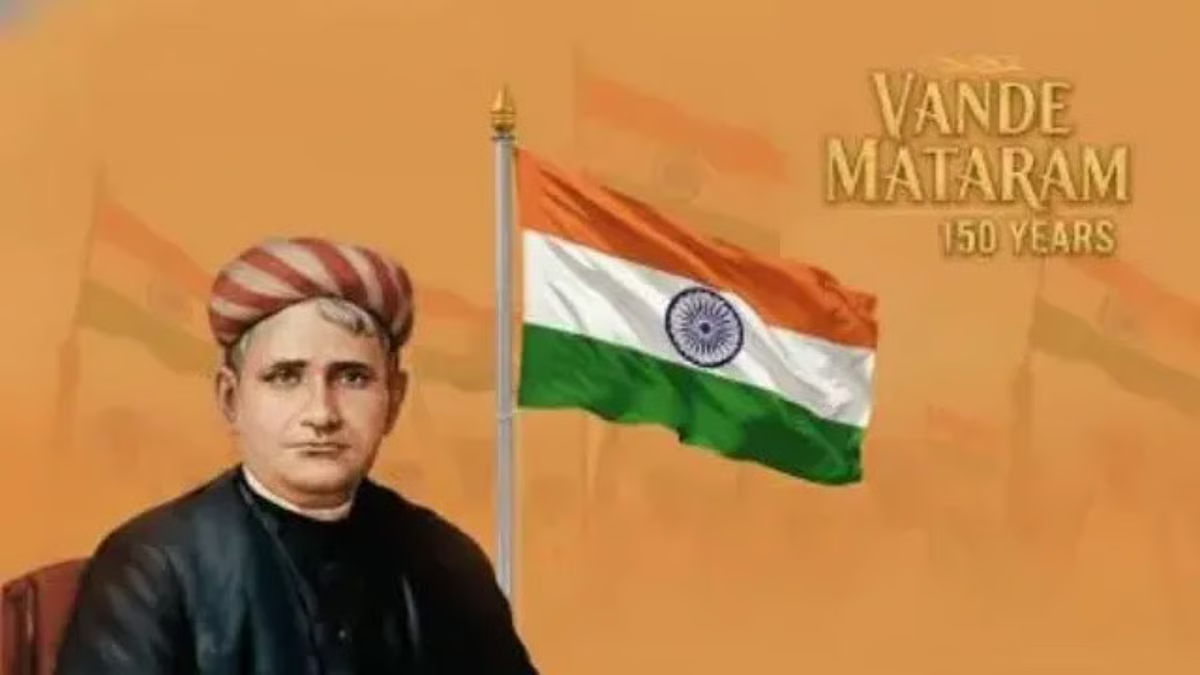
    • Written by Bankim Chandra Chatterjee around 1875, the song celebrates India's landscape and cultural identity.
    • The first two stanzas are acknowledged as universally representative of the motherland, whereas later stanzas invoke specific Hindu deities.
    • The Indian National Congress in 1937 adopted only the first two stanzas amid communal sensitivities, a decision endorsed by key leaders like Rajendra Prasad and Vallabhbhai Patel.

    Recent Developments

    • In January 2026, the Home Ministry ordered that all six stanzas be sung at official functions, requiring attendees to stand at attention.
    • The second order in July 2026 officially designated the six-stanza version as the National Song, placing it ahead of the National Anthem.

    Judicial and Public Reactions

    • The Supreme Court is yet to make a decisive ruling but is reviewing the balance between national identity and individual rights, as highlighted by public debates.
    • The Solicitor General’s response highlighted concerns about associating dissent with extremist ideologies.

    National Sentiments and Suggestions

    • Proposal for 'Vaishnava Jana To': Suggested as India's National Prayer, indicating a more inclusive approach to national identity without compulsory singing or penalties.
    • The argument emphasizes that genuine national sentiments cannot be legislated or enforced through coercion.

    Economic and Demographic Context

    • India's population stands at 1.4 billion, prompting discussions about the essence of national identity versus compulsory expressions.
    • Inclusion Over Compulsion: The narrative advocates for a national culture that thrives on understanding and empathy rather than enforced adherence to symbols.

    Summary of Views

    • 'Vande Mataram' tests allegiance to the nation, while 'Vaishnava Jana To' is centered on moral conduct and mutual respect.
    • The constitutional ideals promote equal treatment and respect for diverse expressions of citizenship.

    Conclusion

    Discussions surrounding 'Vande Mataram' and its legislative context encapsulate a broader dialogue about nationalism, individual rights, and respect for diverse cultural expressions in a pluralistic society. The ongoing judicial scrutiny reflects the need for a balanced approach to national symbols that honors both collective identity and personal freedoms.

    Gandhi's Advocacy for Universal Voting Rights
    Polity and Governance02-Oct-2026

    Gandhi's Advocacy for Universal Voting Rights

    Summary Notes: Mohandas Gandhi and the Right to Vote

    1. Historical Context:

      • Mohandas Gandhi's first political battle was for the right to vote during his time in South Africa against colonial disenfranchisement.
      • In July 1894, the Natal government proposed the disenfranchisement of Indians, which Gandhi challenged by petitioning Lord Ripon, emphasizing the loss of self-respect for Indians without voting rights.
    2. Gandhi's Advocacy for Universal Adult Franchise:

      • During the 1920s, Gandhi communicated through publications such as Young India and Harijan, asserting that universal adult franchise should be immediate, compelling the powerful to listen.
      • He advocated for voting rights for all individuals regardless of wealth, education, gender, or caste, demonstrated at the 1931 Round Table Conference.
    3. Manipulation of Voter Lists:

      • Gandhi recounted an incident from 1896 in Durban where his name was included in electoral rolls without consent, highlighting issues of electoral integrity and manipulation.
  • Constitutional Framework:

    • India adopted universal adult franchise at the Republic’s founding in 1950, inspired by Gandhi's advocacy.
    • The sanctity of voting as a constitutional right is emphasized, contrasting the current situation where voter lists are manipulated, resulting in disenfranchisement.
  • Critique of Current Voting System:

    • The ongoing SIR (specific mention of a current controversy) threatens to mock the constitutional rights of citizens by potentially reducing the electorate through improper revisions of voter rolls.
    • Gandhi’s three tests for fair voting procedures are reiterated:
      • Does revision increase or diminish citizen self-respect?
      • Is the voter roll prepared impartially or favoring certain candidates?
      • Is the vote viewed as a protected right or a granted privilege?
  • Judicial and Ethical Considerations:

    • The practice of mass disenfranchisement is labeled as "civicide" and "disfranchiside," pointing to deliberate actions to erode citizen rights.
  • Significance of Gandhi Jayanti:

    • Gandhi Jayanti serves as a reminder of the values Gandhi stood for regarding voting and democratic participation, emphasizing the importance of each name on an electoral list as a fundamental right.
  • Conclusion:

    • Highlighting the importance of citizen rights and the ethical responsibility of the state's administrative machinery to uphold the law and constitutional provisions in electoral processes, reflecting Gandhi's enduring legacy on the right to vote.