iAspirants
Current AffairsPrelims PYQsUPSC CSE SyllabusUPSC CSE StrategyBlogsPricing
Login
iAspirants

Your AI-powered companion for UPSC preparation.

Quick Links

  • Home
  • About Us
  • Current Affairs
  • Prelims PYQs
  • UPSC CSE Syllabus
  • UPSC CSE Strategy
  • Blogs

Company

  • Pricing
  • FAQs
  • Contact Us
  • Login

Legal

  • Privacy Policy
  • Terms & Conditions
  • Return Policy

© 2025 iAspirants, Inc. All rights reserved.

  1. Blogs
  2. Economic and Social Development

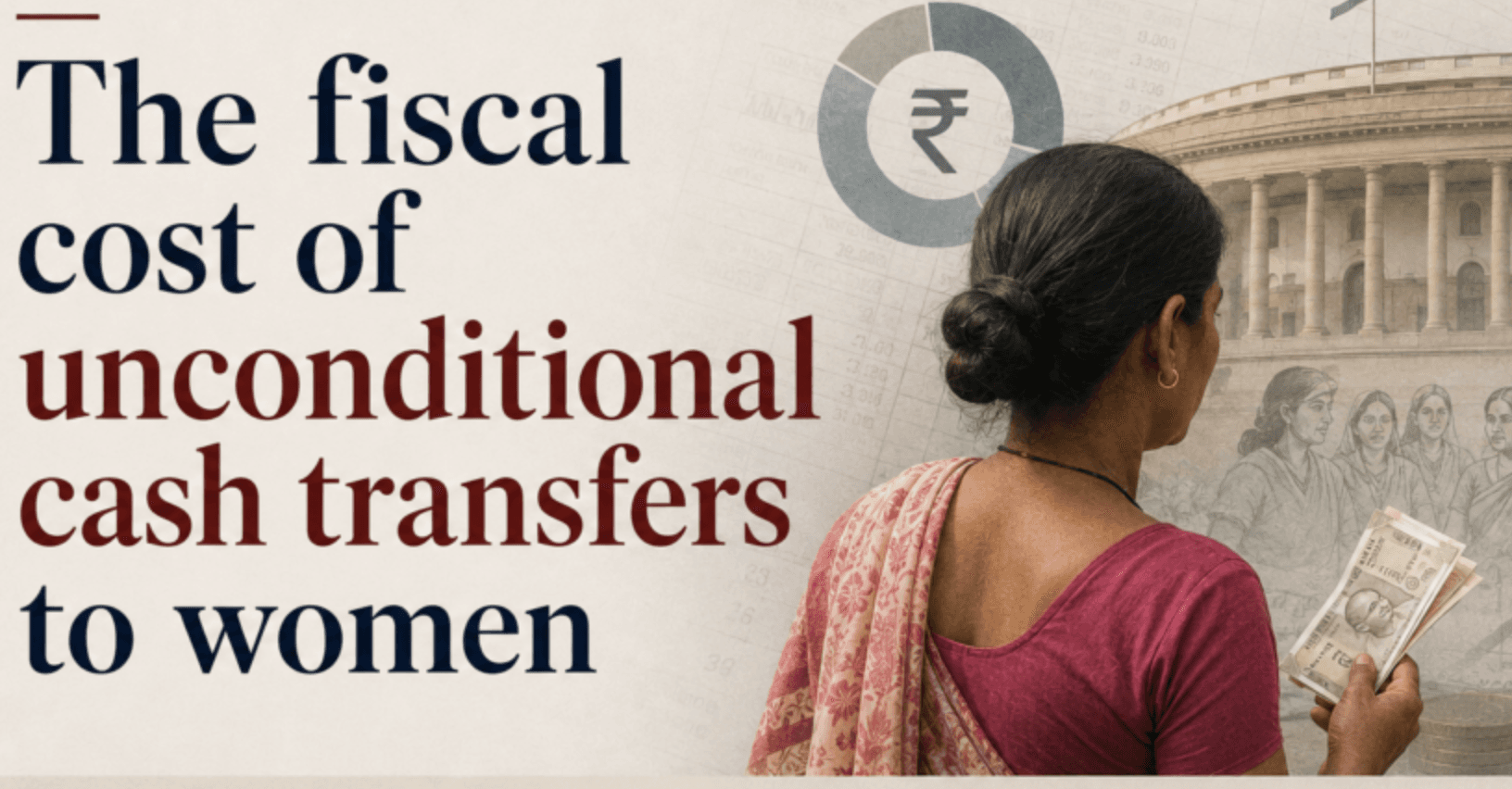
Unconditional Cash Transfer Schemes in India

Published on: 07-Sep-2026

Share this post

Unconditional Cash Transfer Schemes in India

Article Summary

Exam-Focused Notes on Unconditional Cash Transfer (UCT) Schemes in India

Overview of UCT Schemes

  • Importance: UCT schemes, introduced since 2020, are seen as electoral strategies particularly aimed at women voters.
  • Key Examples:
    • Kalaignar Magalir Urimai Thittam (Tamil Nadu)
    • Lakshmir Bhandar (West Bengal)
    • Gruha Lakshmi Yojana (Karnataka)

Economic Data

  • Projected Expenditure: By 2025-26, states are expected to spend around $18 billion on UCTs, predominantly benefiting women.
  • Budget Impact: UCT financing can lead to expenditure switching or larger fiscal deficits, limiting productive investments.

Constitutional References & Policies

  • Sustainable Development Goals: UCT initiatives partially support SDG 5.4, which underscores the importance of recognizing women’s unpaid domestic and care work.

Challenges of UCT Programs

  • Beneficiary Identification:

    • Reliance on proxy indicators (land ownership, electricity consumption, household assets) can cause:
      • Inclusion Errors: Non-eligible households receiving benefits.
      • Exclusion Errors: Eligible households missing out on benefits.
  • Political Costs: Perceived and actual errors in beneficiary targeting could influence voter preferences negatively.

Noteworthy Scheme Implementations

  • Kalaignar Magalir Urimai Thittam:

    • Initially promised ₹1,000/month for all women-headed households.
    • Adjusted eligibility criteria due to fiscal constraints in September 2023.
    • First covered 1.13 crore women; expanded by 16.94 lakh beneficiaries in December 2025.
    • Total scheme cost for 2025-26 is ₹13,807 crore.
  • Lakshmir Bhandar:

    • Launched in 2021 to assist women with monthly stipends, faced controversy over including non-resident citizens.

Political Dynamics

  • Electoral Consequences: Recent UCT implementations have not guaranteed electoral victories, raising questions about the effectiveness of such schemes in securing voter loyalty.
  • Dissatisfaction Among Beneficiaries: Issues with eligibility lead to public grievances, impacting political support.

Alternatives and Recommendations

  • Conditional Cash Transfers (CCT):

    • Linking benefits to desirable social outcomes, such as educational enrollment (e.g., Tamil Nadu’s Midday Meal Scheme), results in fewer grievances and maintains the welfare goal without extensive political costs.
  • Designing Future Welfare Policies: Recognizing the tension between economics (favoring targeted programs) and politics (favoring broader inclusion) can help in formulating better welfare strategies.

Summary

While UCT schemes aim to empower women and support economic stability, they encounter significant political and administrative challenges. Future welfare policies may benefit from implementing conditional benefits to minimize political backlash and enhance developmental outcomes.

Key Terms & Concepts

Unconditional Cash Transfer (UCT)financial support to women
Kalaignar Magalir Urimai Thittamcash assistance to women
Lakhsmir Bhandarmonthly assistance to women
Gruha Lakshmi Yojanafinancial support for women
Sustainable Development Goal 5.4recognition of unpaid work
$18 billionexpected state expenditure on UCTs
₹1,000promised monthly cash
₹13,807 crorecost of UCT scheme 2025-26
1.13 crorewomen covered initially
16.94 lakhadditional beneficiaries added
September 2023launch date of scheme
December 2025date of adding beneficiaries
Midday Meal Scheme

Mind Map for UPSC Civil Services Revision

Turn UPSC Civil Services Current Affairs Into Exam-Ready Notes

Reading Economic and Social Development current affairs is half the work. Revise them with ready-made notes and test what actually stuck.

  • Daily UPSC Civil Services current affairs analysis
  • Revision notes, mind maps & MCQs
  • Prelims mock tests with instant results

Related UPSC Civil Services Current Affairs Articles

Upcoming 18th BRICS Summit Insights
International Relations07-Sep-2026

Upcoming 18th BRICS Summit Insights

Summary of the 18th BRICS Summit Highlights

Dates and Location

  • Event: 18th BRICS Summit
  • Dates: September 12-13, 2026
  • Location: New Delhi, India

Key Themes and Principles

conditional welfare program example
  • Chinese Support: China expresses full support for India's BRICS presidency.
  • ** BRICS Vision**: Emphasis on multipolarity, economic globalization, and the Global South's collective rise.
  • UN Charter Allegiance: BRICS should uphold the principles of the UN Charter, including sovereign equality and non-interference.
  • Key Areas of Cooperation

    1. Openness in Global Economy:

      • Protectionism Concerns: Acknowledgment of rising protectionism disrupting international trade and supply chains.
      • WTO Principles: Commitment to the multilateral trading system with the WTO at its core.
      • Energy and Infrastructure Cooperation: Importance of collaboration in energy, minerals, and industrial supply chains.
    2. Win-Win Development:

      • UN Sustainable Development Goals: Focus on accelerating implementation and formulating the post-2030 global development agenda.
      • Mutual Benefit Agreements: Stronger coordination on macroeconomic policies and promotion of local currency cooperation.
    3. Economic Synergy:

      • Statistical Insights: BRICS accounts for nearly 50% of the world population, 30% of global economic output, and 20% of global trade.
      • Future Growth: Forecasted growth of greater BRICS expected to be three times faster than G-7 by 2028.
    4. Technological Advancements:

      • AI Integration: Promotion of AI integration across sectors like agriculture, health, and education.
      • Research Centers: Establishment of the China-BRICS AI Development Center and Quality Productive Forces Research Center.
    5. Shared Responsibilities:

      • Peace and Cooperation: Emphasis on BRICS as a force for fairness and justice in international relations.
      • Enhancing China-India Relations: Noted improvement in bilateral relations, including restored trade routes and travel links.

    Economic Indicators

    • Growth Statistics: Greater BRICS growth projected to triple that of G-7 by 2028, highlighting significant roles in global economic dynamics.

    International Relations

    • China-India Coordination: Importance of sound coordination between India and China during consecutive presidencies for enhancing BRICS cooperation.
    • COVID-19 Resilience: Resumption of flight routes and border trade after prior suspensions, reflecting enhanced connectivity and economic ties.

    Strategic Insights

    • China's Global Initiatives: Four global initiatives proposed by China for addressing human challenges and promoting collective development.

    Conclusion

    • The 18th BRICS Summit aims to cement greater cooperation among member countries while promoting a stable global environment characterized by unity, openness, and shared growth opportunities.
    Healthcare Gap in India Highlighted
    Economic and Social Development04-Sep-2026

    Healthcare Gap in India Highlighted

    • Healthcare Vulnerability: Over 40 crore Indians are reportedly caught in a healthcare gap, constituting more than a quarter of the population. This group is too wealthy to rely on government subsidies yet not financially secure enough to afford rising private healthcare costs.

    • Parliamentary Report: A report by the Parliamentary Standing Committee on Health and Family Welfare, titled ‘Affordability and Accessibility of Healthcare Facilities in Public and Private Sector,’ outlines this healthcare gap and makes 368 recommendations aimed at improving affordability and accessibility.

    • Healthcare Delivery: More than 60% of inpatient care and 70% of outpatient care in India are delivered by the private sector, leaving many households without adequate financial protection from high private costs.

    • Health Expenditure: Medicines account for nearly 30% of current health expenditure, creating a substantial financial burden for individuals, particularly those with chronic conditions like diabetes, hypertension, and cardiovascular disease.

    • Public Spending on Health: The report highlights a structural issue in the healthcare system, noting that government health expenditure stands at 1.43% of GDP, lower than the 2.5% target specified in the National Health Policy, 2017. Additionally, health spending as a share of total government expenditure decreased from 6.12% in 2021-22 to 4.89% in 2022-23.

    • Out-of-Pocket Expenses: The average out-of-pocket expenditure on childbirth in private facilities is approximately ₹37,630, compared to ₹2,299 in public facilities, indicating a significant disparity in costs.

    • Government Schemes: The Ayushman Bharat - PM-JAY scheme provides hospitalization coverage for vulnerable households. However, those in the 'missing middle' often do not qualify for these fully subsidized services, leaving them vulnerable to high healthcare costs.

    • Insurance Challenges: The report asserts that private insurance may not adequately protect households due to issues like high premiums, exclusions, waiting periods, and co-payments. Thus, merely providing insurance is not a solution to the healthcare gap.

    • Recommendations for Improvement: The Committee calls for:

      • Strengthened public healthcare infrastructure.
      • Nationwide implementation of the Clinical Establishments Act.
      • Mandatory quality standards and greater price transparency in private healthcare facilities.
      • Stricter regulations on pharmacy practices, including excessive trade margins and the non-prescription sale of antibiotics.
    • Conclusion: The report emphasizes the need for more than just insurance coverage to address healthcare gaps. There's a crucial need to protect the millions who fall between the wealthy and the impoverished, as their financial vulnerabilities accumulate from the ongoing costs of maintaining health, rather than from single medical emergencies.

    Decentralized Grain Storage Initiative in India
    Economic and Social Development03-Sep-2026

    Decentralized Grain Storage Initiative in India

    Decentralized Grain Storage Scheme in Cooperative Sector - Key Facts and Insights

    Overview

    • Scheme Launch: Initiated in May 2023 under the Ministry of Cooperation.
    • Objective: To enhance storage, processing, procurement, and distribution systems via Primary Agricultural Credit Societies (PACS).
    • Target: Improve food security and reduce grain wastage.

    Capacity and Implementation

    • Initial Capacity: 9,750 metric tons across 11 states as pilot projects.
    • Expansion by July 2026: Construction of warehouses in 313 PACS completed, yielding over 180,000 metric tons of storage capacity.
    • Participating States: Maharashtra, Uttar Pradesh, Gujarat, Rajasthan, Madhya Pradesh, Uttarakhand, Tamil Nadu, Telangana, Assam, Karnataka, Tripura.

    Economic Data

    • Projected Food Grain Production (2025-26): Estimated at 376.563 million tons, up from 357.732 million tons in the previous year (increase of 5.3%).
    • National Food Security Act, 2013: Covers approximately 800 million people, representing the world’s largest food security program.

    Government Schemes and Financial Support

    • Supporting Schemes:

      • Agricultural Infrastructure Fund (AIF): Provides financial support for post-harvest infrastructure.
      • Agricultural Marketing Infrastructure Scheme (AMI): Offers capital subsidy for storage facilities.
      • Sub-Mission on Agricultural Mechanization (SMAM): Facilitates access to agricultural machinery.
      • PM Micro Food Processing Enterprises Scheme (PM-FME): Aims to formalize and promote micro food processing units.
    • Financial Assistance:

      • Subsidy under AMI increased from 25% to 33.33%.
      • Margin money requirement reduced from 20% to 10%.
      • Effective interest rate for PACS can be as low as 1% after subsidies.

    Implementation Framework

    • Implementing Agency: National Cooperative Development Corporation (NCDC).
    • Coordination: Inter-ministerial committee for overall implementation; state and district cooperative development committees for local coordination.
    • Quality Assurance: Standardization of storage infrastructure, regular inspections, and adherence to quality norms.

    Benefits and Impact

    • Reduced Transportation Costs: Facilities located closer to production centers decrease costs.
    • Enhanced Farmer Income: Allows farmers to avoid distress sales and obtain better prices.
    • Job Creation: Local employment opportunities arise from improved storage facilities.
    • Community Support: PACS provide short-term loans and financial services to enhance farmers’ income.

    Quality Standards and Transparency

    • Branding Guidelines: Each storage unit must display an approved 'Grain Storage Logo' for identification.
    • Environmental Considerations: Storage structures must comply with local environmental conditions and maintain grain quality.

    Conclusion

    The decentralized grain storage scheme in the cooperative sector represents a significant step towards improving agricultural infrastructure, enhancing food security, and strengthening rural economies. By integrating various government initiatives and focusing on local needs, the scheme aims to create a robust network for grain management in India.

    India-France Textile Cooperation Agreement
    Economic and Social Development03-Sep-2026

    India-France Textile Cooperation Agreement

    Summary Notes on India-France Textile and Fashion Cooperation

    1. Strategic Partnership:

    • India Textile Trade Federation (BTTF) and Première Vision SA signed a Memorandum of Understanding (MoU) on September 2, 2026, at the Première Vision exhibition in Paris.
    • Aim: Strengthen India's participation in the global fashion and textile ecosystem through a multi-year institutional partnership.

    2. Key Figures:

    • The MoU was signed by Dr. A. Shaktivel, BTTF core committee member and chairman of the Apparel Export Promotion Council (AEPC), and Florence Roustan, CEO of Première Vision SA.
    • The signing was attended by significant industry leaders and officials, including Neelam Shami Rao, Secretary of the Ministry of Textiles, and M. Bina, Commissioner for Handloom Development.

    3. Background:

    • This MoU is based on a Letter of Intent signed on July 14, 2026, during India Tex 2026, emphasizing continuous collaboration in trade, sourcing, design, sustainability, and heritage.
    • The partnership is timely with the conclusion of negotiations for the India-EU Free Trade Agreement (FTA) in January 2026.
    US Sanctions Impact on India 2026
    Economic and Social Development03-Sep-2026

    US Sanctions Impact on India 2026

    Key Highlights and Facts

    Legislative and Economic Developments

    • Lindsey O. Graham Sanctioning Russia and Iran Act of 2026
      • Recently passed by the U.S. Senate, imposing sanctions specifically on Russia and Iran.
      • Authorizes tariffs up to 100% on countries among the largest importers of Russian crude oil or natural gas that continue purchases post-enactment.

    India’s Economic Interests

    • India has recently diversified its energy supplies, increasing Russian crude imports significantly:

      • Before the Russia-Ukraine conflict, only 2% of India's crude oil imports were from Russia; now it constitutes approximately 50%.
      • Imports surged from 4.54 MMT in January to 8.96 MMT in May 2026.
    • The U.S. sanctions could impose a cumulative tariff of 110% on India, severely impacting its price competitiveness in the U.S. market, a key export destination.

    Tariff Implications

    4. Economic Impact:

    • EU's global textile and apparel imports were approximately USD 292.8 billion in 2025.
    • Current textile and apparel exports from India to the EU are about USD 10.4 billion.
    • The FTA proposes preferential market access covering 96.8% of tariff lines, with expectations of duty-free status for 90.7% of exports based on trade value.

    5. Government Initiatives:

    • The partnership aligns with Prime Minister Narendra Modi's 5F vision, which focuses on "Farm to Fibre to Fashion to Foreign" as a comprehensive strategy for the textile sector.
    • Aims to transition Indian textile exports from volume-based to high-value, design-centric segments.

    6. Collaboration Areas:

    • Delegation and Knowledge Sessions: Mutual participation in trade exhibitions, supported by joint export promotion and buyer-seller meetings.
    • Export Promotion and Market Access: Joint initiatives to enhance market access and facilitate buyer-seller interactions.
    • Sustainability: Promotion of circularity, traceability, and responsible production practices.
    • Heritage and Craftsmanship: Establishment of a permanent craft collaboration to showcase Indian and French textile heritage, including a "Living Thread" exhibition in January 2027.

    7. Outcomes Expected:

    • Enhanced connection of Indian textile manufacturers, exporters, designers, and artisans with international buyers and premium sourcing networks.
    • Increased competitiveness of Indian textiles in the EU market, particularly in clothing, fabrics, threads, and home textiles.

    8. Implications for Indian Textile Sector:

    • The partnership is expected to create significant opportunities for Indian exporters and enhance India's position as a sustainable, innovative, and high-value sourcing destination in the global fashion industry.
    • It aims to showcase India's rich textile heritage while promoting sustainability in textile production.

    This MoU marks a critical step in integrating India's textile sector into the global market, leveraging international collaborations to elevate the industry's standards and reach.

    • On July 24, the U.S. imposed forced-labor tariffs on 60 countries, including India, resulting in an additional 10% tariff under Section 301 of the Trade Act of 1974.
    • These tariffs may result in substantial economic losses for India, with cumulative tariffs potentially reaching 110%.

    Trade Simulations

    • Two global trade simulations using the GTAP dataset:
      1. Sanction Scenario:
        • India’s welfare declines by nearly $47 billion.
        • Projected reductions in GDP, output, and aggregate exports by 5.1%.
      2. Diversification Scenario:
        • In contrast, with a functional India-EU Free Trade Agreement (FTA), welfare improves by $26.3 billion, and aggregate exports increase by 3.1%.

    Recommendations

    • Encouragement of export diversification and strengthening ties with alternative markets, particularly the EU, is critical for mitigating adverse effects from U.S. tariffs.
    • Domestic reforms including:
      • Trade facilitation.
      • Removal of non-tariff barriers.
      • Improved logistics.
      • Enhancing goods quality standards.

    Strategic Insights

    • The adverse impact of tariffs could be mitigated through enhanced trade relations and export diversification, indicating the need for India to evaluate market opportunities beyond the U.S.
    • Sustained domestic reforms will enhance India's resilience to geopolitical shocks and improve long-term export competitiveness.

    Conclusion

    • The enactment of the U.S. sanctions poses a significant economic challenge to India, particularly in its energy imports from Russia. However, through strategic diversification and domestic reforms, India can navigate the potential pitfalls and bolster its economic stability and global trade position.